Hydrographic printing, also known as water transfer printing or immersion printing, is a process that applies a printed pattern to a three dimensional object by floating a film on water and dipping the object through it, so the design wraps evenly around complex, curved surfaces. It lets an award carry rich graphics on shapes that flat printing cannot reach.
Most printing methods assume a flat or simple surface. Awards, especially sculptural ones, are anything but flat. Hydrographic printing solves that problem elegantly, using the surface of water to conform a printed film around contours, curves, and undercuts. It opens up decorative possibilities that would otherwise be impossible on a three dimensional recognition piece.
How hydrographic printing works
A thin printed film carrying the chosen pattern is laid onto the surface of a water bath, where it softens. An activator is sprayed on, turning the printed layer into a liquid ink film that floats on the water. The object, already primed and base coated, is then slowly dipped through the floating film. As it passes through, water pressure wraps the ink around every surface it touches, and because the film flows with the water it reaches into recesses and around curves. The object is rinsed, dried, and sealed with a protective clear coat.
The result is a continuous printed surface that follows the geometry of the object as if it had been painted on by hand, but with perfect pattern consistency.
Why it matters for premium awards
Hydrographic printing lets an award carry sophisticated finishes such as carbon fibre textures, wood grains, stone effects, metallics, and custom brand patterns, all wrapped seamlessly around a three dimensional form. For a client who wants a distinctive material look without the cost or weight of the real material, this is a powerful option. It also allows brand graphics to flow around a sculptural piece rather than being confined to a flat plate.
Because the pattern is continuous and seamless, the finish looks integral to the object rather than applied, which is exactly the impression a premium piece should give.
Which parts suit the process
Rigid three dimensional components that can be dipped are ideal, including printed, metal, and moulded parts. The surface must be prepared and base coated first, so the process suits pieces where a painted foundation is appropriate. Highly transparent awards meant to show internal detail are usually finished differently. We assess suitability during design, alongside the substrate options shown in our materials overview.
Hydrographic printing versus flat printing
Flat printing methods apply graphics precisely to a plane and are perfect for plates and panels. They cannot wrap around a curved or contoured form without distortion. Hydrographic printing sacrifices some registration precision but gains the ability to cover complex geometry seamlessly. In practice the two are complementary: a flat plate might carry precise text while the body of the award wears a hydrographic pattern.
What the finish looks and feels like
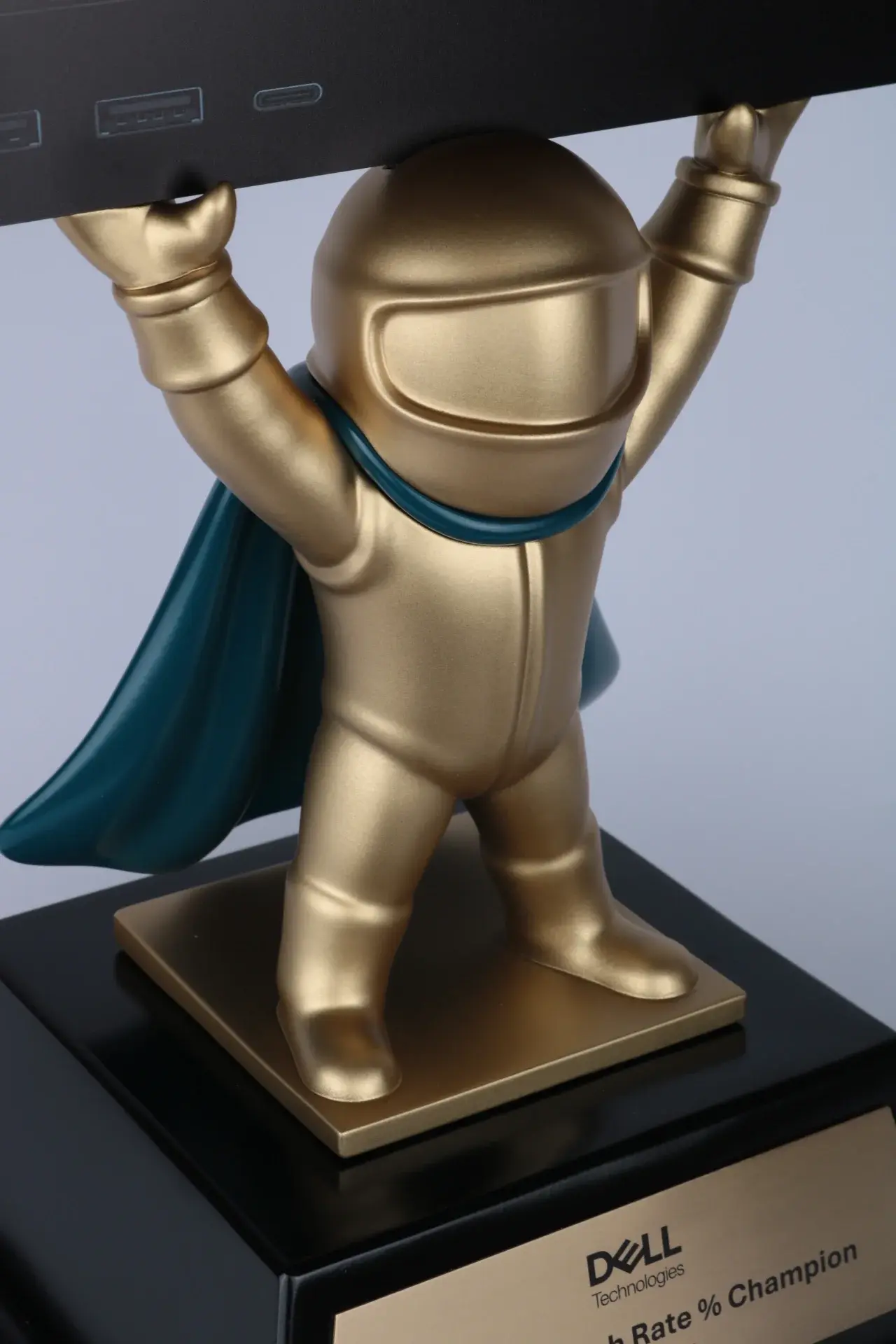
A hydrographic finish looks like a fully integrated surface texture, whether that is the weave of carbon fibre, the grain of timber, or a bespoke brand motif. Sealed under a clear coat, it feels smooth and solid, and it is durable against everyday handling. The pattern flows over edges and around curves without visible seams, which is the signature that distinguishes it from a decal or sticker.
Design considerations before you commit
- Base colour: the underlying base coat influences the final appearance, so it is chosen deliberately.
- Pattern scale: patterns stretch as they wrap, so scale is planned around the object size.
- Registration: exact placement of a specific graphic point is less precise than flat printing, which we account for in the design.
- Sealing: a protective clear coat is applied for durability and can be matte or gloss.
- Combination: flat printed or engraved plates can be added for crisp text against the wrapped pattern.
How Fabit approaches it
Hydrographic printing is a multi stage process where preparation determines the outcome, and keeping it in house means our team controls priming, dipping, and sealing to a single standard. That control is what turns a decorative technique into a dependable premium finish. You can see how it complements our other methods on the custom trophies service page, and it pairs especially well with the complex shapes possible through our 3D printed trophy approach.
Every project receives a response within twenty four hours, and we deliver finished awards worldwide.
Frequently asked questions
Is hydrographic printing durable?
Yes. Sealed under a clear protective coat, the finish resists everyday handling and wear well, comparable to a quality painted surface.
Can any pattern be used?
A wide range of stock and custom patterns is possible, from carbon fibre and wood grain to bespoke brand designs, subject to how the pattern behaves when wrapped.
Does the pattern line up perfectly every time?
The pattern is seamless and continuous, but exact registration of a single point is less precise than flat printing. We design with that in mind.
Can text be added over a hydrographic finish?
Yes. We often add engraved or flat printed plates for crisp, legible text against the wrapped background.
Why preparation decides the result
The dip itself is the most photogenic stage of hydrographic printing, but the outcome is largely decided before the part ever touches the water. The surface must be cleaned meticulously, primed, and base coated in the right colour, because any dust, grease, or unevenness at this stage will show through the final pattern. The activator must be applied at exactly the right moment and quantity to bring the film to the correct state, and the dipping angle and speed have to suit the geometry of the part. After the dip, thorough rinsing removes the residual film carrier, and only a properly cured clear coat locks in durability. Every one of these steps is an opportunity for a mediocre result, which is why the technique rewards a disciplined, controlled workflow rather than a rushed one.
Hydrographic printing is how a three dimensional award gains a rich, wrapped surface that looks and feels integral to the object. It brings the visual language of premium materials to shapes that flat printing could never cover. Explore the possibilities in our online design studio.
Related terms