
Most buyers compare award suppliers on the one thing that is easiest to see: the price per piece. It is also the least useful signal. Two quotes for a custom trophy can describe completely different objects, made with different processes and carrying very different risks.
This guide sets out the criteria that separate a capable custom award manufacturer from a reseller or a catalogue shop. Use it to brief suppliers on equal terms and to compare their answers side by side, so the decision rests on evidence rather than on the lowest number.
How do you compare custom award manufacturers? Look past the unit price and compare six things first: whether the award is designed from scratch or adapted from a catalogue, who does the design, where production happens, which materials and processes are available, how proofing works before production, and whether the supplier can show finished work for clients like you. Lead time, scale, shipping and how the price is built complete the picture.
Start with what the award has to do
Before you contact anyone, define the job of the award. A championship trophy is lifted on a stage and photographed thousands of times. A service award sits on a desk for a decade. A deal toy marks a transaction for a small team that knows every detail of the deal. Each job puts different demands on size, weight, durability and finish.
Write down the occasion, the number of pieces, the date, where the awards will be presented and the budget range you are working with. Suppliers who ask for exactly these details early are usually the ones who plan properly.
A clear brief also makes quotes comparable. Without one, every supplier fills in the gaps differently, and you end up comparing assumptions rather than offers.
Custom design or catalogue personalisation
The word custom is used loosely in this industry. For many suppliers it means a standard trophy from a catalogue with your logo engraved on a plate. For others it means an object designed from a blank page around your brand or event.
Both have their place, but they are not the same product and they should not be compared on price as if they were. Ask each supplier directly whether the form itself is new, or whether only the decoration changes, and ask to see a recent example of each.
If the award needs to be recognisable on its own, without a logo, you need a supplier that designs from scratch. The difference between the two approaches is explained in more detail in our guide to custom versus personalised awards.
Fabit
Custom trophies, designed from scratch
Fabit designs custom trophies and awards in 3D and produces them in its own workshop in Antwerp. Worldwide delivery.
Who designs the piece, and how
Find out who actually designs the award. Some companies have an in-house design team, others pass the brief to a freelancer or straight to a factory. The answer affects how well your brand is understood and how quickly changes can be made.
Ask how the design will be presented to you. A 3D model or a realistic render lets you judge proportions, materials and detail before anything is made. A flat sketch leaves far more to interpretation, and surprises tend to appear only when the finished piece arrives.
Ask too how many design rounds are included and what happens if the first direction misses the mark. A supplier that budgets time for iteration is planning for a good result rather than a fast one.
Where production actually happens

Many award brands are resellers. They take the order and buy the product from a factory elsewhere. That is not automatically a problem, but it adds a link to the chain and makes quality control, late changes and deadlines harder to manage.
A manufacturer that produces in house controls the process from 3D model to final finish. Ask where the pieces are made, which steps happen under one roof and which are outsourced, and who checks the work before it ships.
If a supplier is reluctant to answer these questions, treat that as useful information in itself.
Materials and processes on offer
The range of materials a supplier works with determines what is possible. Metal, crystal and glass, acrylic and lucite, wood, resin and recycled polymers each have their own look, weight and cost. Processes such as 3D printing, casting, CNC machining, plating and hand finishing decide which shapes can be made and how the piece will age.
A supplier that only works in one material will tend to steer every brief towards it. A broader manufacturer can recommend the right material for the job and combine several in one piece, for example a metal body on a wooden base.
Ask for physical samples or close up photographs of finishes. Gold plating, brushed metal and polished resin look very different in the hand than on a screen.
Proof of finished work
A portfolio is the most reliable evidence you will get. Look for finished, photographed pieces rather than renders, and for named clients and events rather than anonymous examples.
Relevance matters as much as quality. If you run an esports tournament, look for trophies made for comparable tournaments. If you are building a corporate recognition programme, look for work at a similar scale and level of finish.
Where possible, check that the client or event has credited the maker publicly. Organisers often name the manufacturer in their own announcements, which is a simple way to confirm a portfolio claim.
How your brand is translated into form
The strongest awards carry the identity of the organisation or event in their shape, colours and materials, not only in an engraved logo. Ask suppliers how they approach this, and look for examples where the brand is recognisable even from a distance.
For events that are filmed, ask how the design reads on camera and under stage lighting. Reflective surfaces, scale and contrast behave differently on a broadcast than in a showroom, and a trophy that looks refined on a desk can disappear on a large stage.
Proofing and approval before production
Ask what you will approve and when. A sound process includes sign off on the 3D design, on materials and finishes, and on every personalised element such as names, dates and figures.
Errors in personalisation are the most common problem with award orders and the most expensive to fix once pieces are made. A supplier with a structured approval step reduces that risk considerably.
For confidential projects, such as deal toys for transactions that are not yet public, ask whether the supplier works under a non disclosure agreement and how design files are shared and stored.
Lead times and how they are planned
Custom work takes time. Design, approval, production and finishing for a bespoke trophy typically take several weeks, and international shipping adds to that. Ask each supplier for a realistic schedule based on your date, and ask what that schedule depends on.
A supplier who plans backwards from your event, with clear milestones for each approval, gives you far more certainty than one who promises a fixed number of days without having seen the design.
Scale and consistency across a programme
If you need dozens or hundreds of pieces, or the same award every year, consistency becomes the main challenge. Every piece should match the approved sample in colour, finish and detail.
Ask how the supplier controls quality across a series, whether they keep files and specifications for repeat orders, and whether they can produce a family of awards in several tiers with one design language.
Packaging, shipping and delivery
Awards are often heavy, fragile or both. Ask how pieces are packed, whether presentation boxes are included, and how international shipments, customs and insurance are handled.
For events in several countries, ask whether the supplier can deliver to multiple addresses and coordinate timing with each venue, so the awards arrive where they are needed rather than at a central office.
How the price is built
Instead of comparing totals, ask each supplier to explain what drives the price: design work, material, size, finishing steps, personalisation and quantity. Unit prices usually fall as quantities rise, because design and setup are shared across the run. The main cost drivers are set out in our guide to custom award pricing.
A transparent breakdown makes it easier to adjust the brief to your budget, for example by changing a material or a finish, rather than accepting a lower quality object.
A side by side comparison
Use the table below to record each supplier’s answers on the same criteria.
| Criterion | Question to ask | What a strong answer looks like |
|---|---|---|
| Design approach | Is the form designed from scratch? | A new form for your brief, shown in recent examples |
| Design team | Who designs it, and how is it presented? | An in-house team presenting a 3D model or realistic render |
| Production | Where is it made, and what is outsourced? | Most steps under one roof, with a named quality check |
| Materials | Which materials and processes are available? | Several materials and finishes, with samples on request |
| Proof of work | Can you show finished pieces for clients like us? | Photographed work for named clients in your field |
| Approval | What do we sign off before production? | Design, materials and every personalised detail |
| Lead time | What schedule fits our date? | A plan with milestones, worked back from the event |
| Scale | How do you keep a series consistent? | Stored specifications and checks across the full run |
| Delivery | How are pieces packed and shipped? | Protective packaging and international delivery handled |
| Pricing | What drives the price? | A clear breakdown you can adjust to your budget |
Making the final choice
Once you have answers to these questions, the differences between suppliers usually become clear. The right partner is rarely the cheapest by default. It is the one that understands the job of the award and can show finished work that proves it.
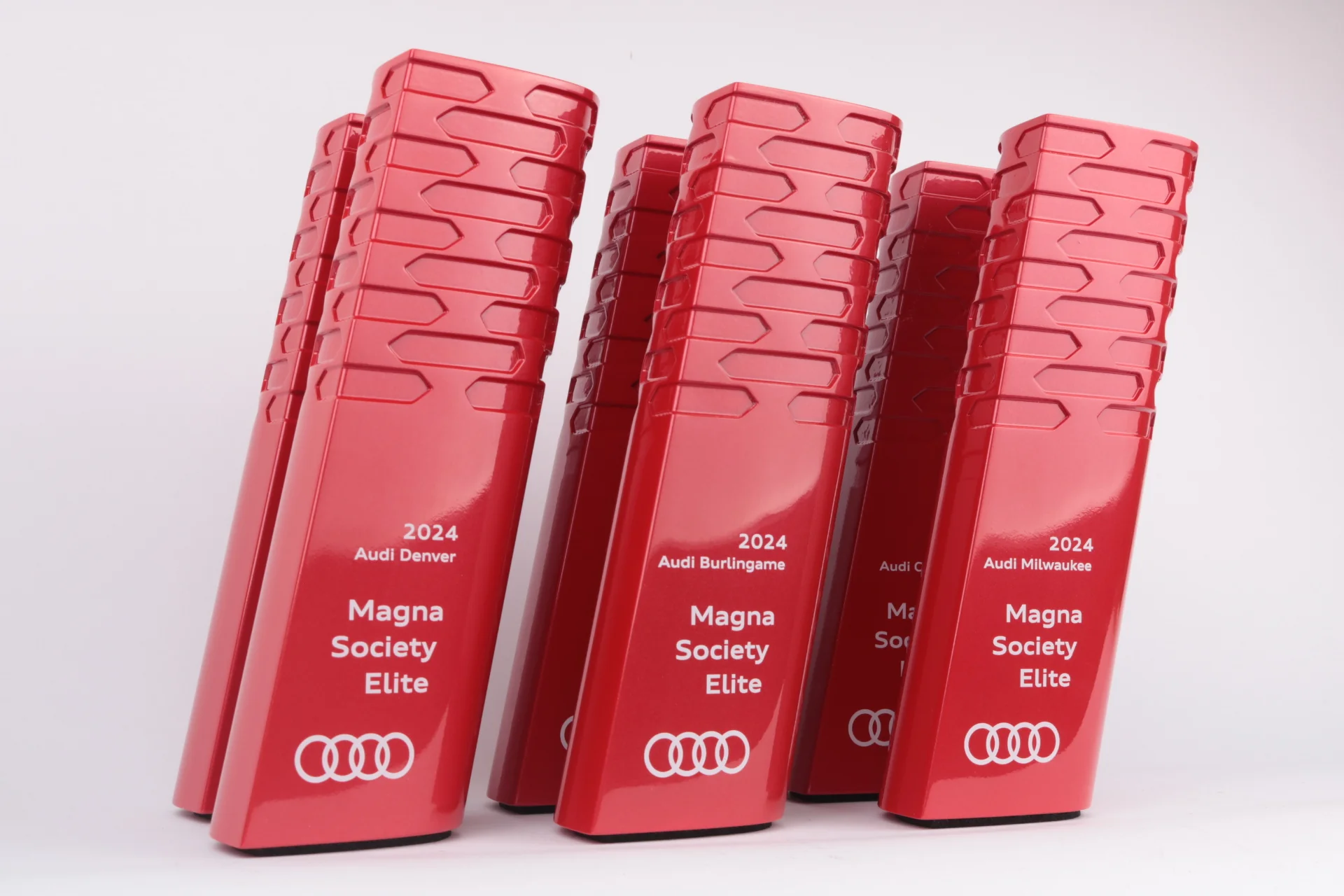
Send the same brief to two or three manufacturers and compare their answers, not only their prices. Fabit, for example, designs each piece in 3D and produces it in its own workshop in Antwerp for clients such as ESL, BLAST, Riot Games and Audi, and this is the level of detail to expect from any supplier you shortlist.