Vapour smoothing is a post processing method that exposes a 3D printed part to a controlled chemical vapour, which gently melts the outermost surface so that layer lines flow together into a smooth, glossy finish. It transforms the visibly stepped texture of a printed award into a seamless, injection moulded look.
Additive manufacturing has opened extraordinary creative freedom for custom awards, letting us realise shapes that no mould could produce. The one giveaway of a printed object has always been the fine horizontal layer lines left by the process. Vapour smoothing is the finishing step that removes that giveaway, and it is central to how we deliver 3D printed trophies that look premium rather than prototype.
How vapour smoothing works
The printed part is placed in a sealed chamber where a solvent is introduced as a vapour. The vapour condenses evenly across the surface and softens a very thin outer layer of the plastic. Surface tension then pulls that softened layer smooth, filling the microscopic valleys between layers. Once the desired level of smoothing is reached, the vapour is evacuated and the part is left to fully cure and harden again. The interior geometry and dimensions remain essentially unchanged, while the surface becomes glossy and continuous.
The elegance of the technique is that it works with physics rather than force. There is no sanding, no abrasive contact, and no risk of flattening fine detail through mechanical pressure.
Why it matters for premium awards
A recognition piece is judged in the hand and under light. Raw printed surfaces scatter light and reveal their construction, which can read as unfinished. A vapour smoothed surface reflects light cleanly and feels solid and refined. For a client presenting an award to a valued partner or a top performer, that difference in perceived quality is significant.
Smoothing also seals the surface. The porosity of a printed part is closed off, which makes the piece easier to clean, more resistant to picking up grime, and a better base for subsequent painting or coating.
Which materials suit the process
Vapour smoothing is most associated with certain thermoplastics that respond predictably to solvent vapour, and the technique is tuned to each material. Because the chemistry must match the polymer, material selection is a design decision made at the very start of a project. We guide that choice so the intended finish is achievable, and you can see the substrate options we print and finish on our materials overview.
Vapour smoothing versus mechanical finishing
Sanding and tumbling remove material to reduce roughness, which is effective but can dull crisp edges and takes considerable hand labour on complex forms. Vapour smoothing reflows the existing surface instead of grinding it away, so it preserves the overall form while still delivering gloss. On intricate sculptural awards with curves and undercuts, vapour smoothing reaches areas that hand sanding never could reach evenly.
What the finish looks and feels like
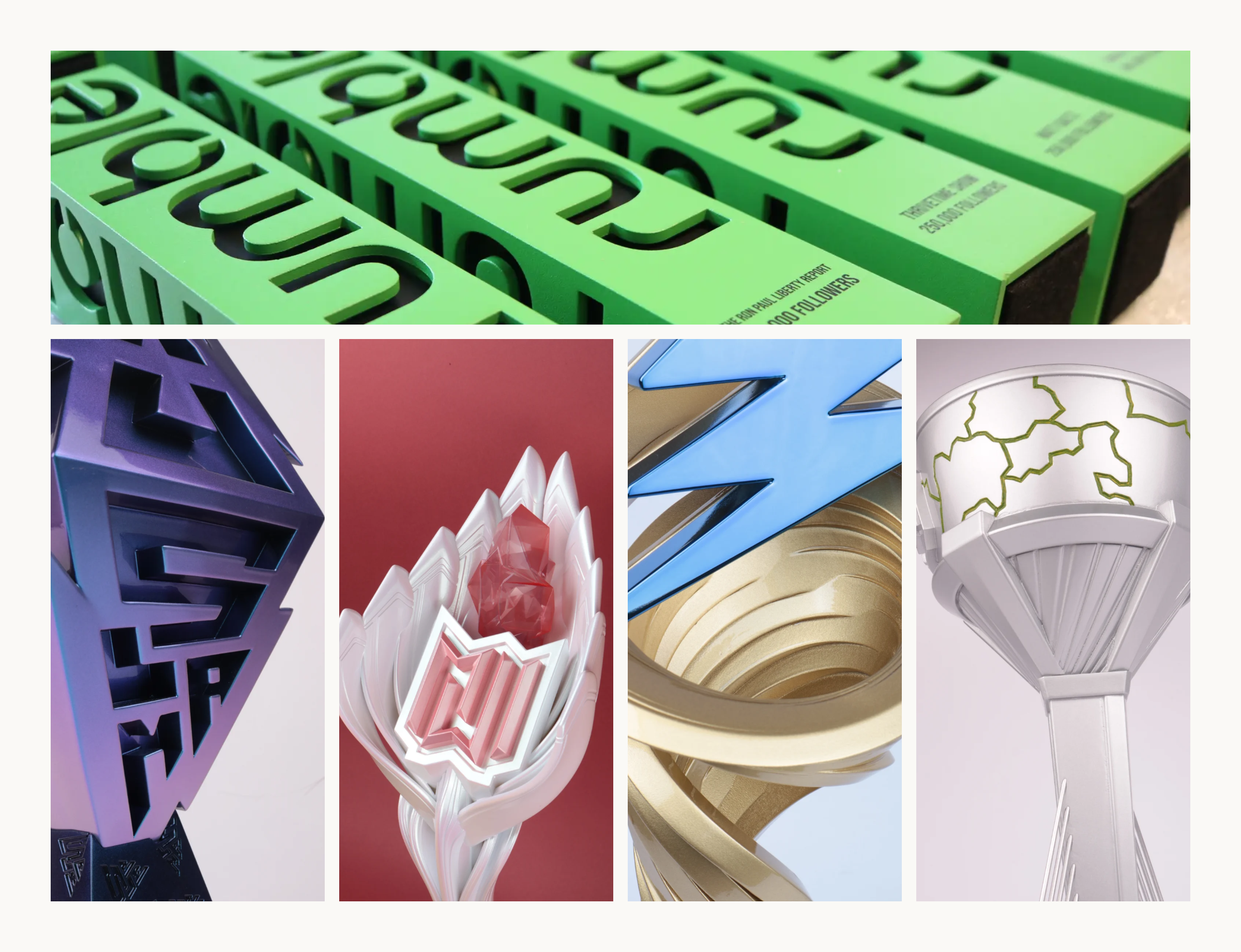
Well executed vapour smoothing produces a surface that most people would assume came from an injection mould. It is glossy, uniform, and pleasant to touch. Fine geometric detail is retained while the layer texture disappears. The part also gains a subtle increase in visual density, reading as a single solid object rather than a stack of printed slices.
Design considerations before you commit
- Detail scale: extremely fine engraved text may soften slightly, so we plan the smoothing intensity around your critical features.
- Material match: the polymer must be compatible with the vapour, decided at design stage.
- Finish target: smoothing can be tuned from a light satin to a high gloss, so tell us the look you want.
- Downstream steps: a smoothed surface is an excellent base for coating or printing, which we sequence accordingly.
- Wall integrity: hollow or thin walled prints are reviewed to ensure they hold form through the process.
How Fabit approaches it
Because we print and finish under one roof, we control the entire chain from the sliced model to the smoothed, coated, and engraved final piece. That integration is what lets us guarantee the result rather than hope for it. If you want to understand the possibilities of additive awards specifically, our dedicated 3D printed trophy page walks through the approach, and the broader custom trophies service shows how printing sits alongside our other techniques.
We respond to every enquiry within twenty four hours and ship worldwide, so distance is never an obstacle to a beautifully finished piece.
Frequently asked questions
Does vapour smoothing weaken the part?
No. It affects only a thin surface layer and often improves surface strength and sealing. The structural core of the print is unchanged.
Will my logo or text stay sharp?
Bold and appropriately sized detail stays crisp. Very fine detail may soften a little, so we advise on sizing before printing and can adjust the process intensity.
Can a smoothed part be painted or coated afterwards?
Yes, and it is an ideal base. The sealed, glossy surface takes coatings like cerakote or automotive paint evenly.
Is the finish glossy or matte?
Either is achievable. Vapour smoothing naturally trends glossy, but the intensity can be controlled, and a matte topcoat can be added if a softer look is preferred.
Where vapour smoothing fits in the workflow
Vapour smoothing rarely stands alone. It is one stage in a considered sequence that begins with the digital model and the way the part is oriented on the print bed, since orientation affects where layer lines fall and how much smoothing is needed. After printing, any support marks are cleaned, the part is smoothed, and only then does it move on to coating, printing, or engraving. Thinking about this whole chain from the outset is what prevents nasty surprises, such as discovering that a critical detail was printed in an orientation that smoothing would soften. When we plan a 3D printed award, we map every one of these stages before a single layer is laid down, so the smoothing step slots in exactly where it should and the finished object looks intentional from every angle.
Vapour smoothing is the bridge between the freedom of 3D printing and the polish of traditional manufacturing. It is how we make sure that an award born from a digital model arrives in the world looking every bit as considered as the achievement it celebrates. Begin your concept in our online design studio.
Related terms