Bead blasting is a surface finishing process in which fine glass beads or other media are propelled at a surface under air pressure, creating a uniform, non directional matte texture with a soft, satin feel that is free of the lines seen in brushed finishes. On trophies and awards, bead blasting produces a refined, even, and tactile surface that reads as modern and understated. Because the texture is uniform in every direction, it has a calm, consistent appearance from any angle, making it a versatile foundation for coloured coatings and a beautiful finish in its own right.
How bead blasting works
In bead blasting, small spherical glass beads are accelerated through a nozzle by compressed air and directed at the workpiece inside an enclosed cabinet. As the beads strike the surface, they create thousands of tiny, overlapping impressions. Because the beads are round rather than angular, they peen the surface gently rather than cutting into it aggressively, which yields a soft, even matte rather than a harsh, coarse texture.
The size of the beads and the air pressure determine the fineness of the resulting finish. Smaller beads and lower pressure produce a very fine, smooth matte, while larger beads create a more pronounced texture. Skilled operators maintain consistent distance, angle, and coverage so the finish is perfectly even across the whole surface. Any inconsistency shows as blotchiness, so uniformity is the mark of expert work.
Why bead blasting suits premium awards
The appeal of a bead blasted finish lies in its quiet, sophisticated uniformity. Unlike a brushed finish, which has a visible grain direction, bead blasting looks identical from every angle. This gives sculptural and geometric forms a serene, cohesive appearance, free of the directional highlights that brushing introduces. For contemporary awards with clean shapes, this consistency is highly desirable.
The surface also has a pleasant tactile quality. It feels soft and slightly velvety to the touch, quite distinct from the slickness of a polished surface or the fine ridges of a brushed one. This sensory character adds to the perceived quality of a piece, rewarding the natural instinct to pick up and handle an award. Bead blasted surfaces are also excellent at hiding fingerprints and minor marks, keeping the piece looking pristine.
Materials suited to bead blasting
- Aluminium: Blasts to a clean, bright, even matte that is popular for modern awards.
- Stainless steel: Produces a durable, sophisticated grey matte with a fine texture.
- Brass and bronze: Gains a soft, muted surface that tempers their natural shine.
- Aluminium prior to anodising: A blasted base gives anodised colours a distinctive matte depth.
The base metal influences the tone and feel of the finish, so we consider material choice and blasting together. Each metal responds differently, offering a range of matte characters.
Bead blasting as preparation for coatings
One of the most valuable roles of bead blasting is as a foundation for coloured coatings. Because PVD, DLC, and anodising follow the texture beneath them, applying them over a bead blasted surface yields a beautifully even matte colour. A blasted then black PVD award, for example, has a deep, uniform, non reflective finish that feels engineered and premium. This combination of texture and colour is a cornerstone of contemporary award design, and we use it frequently within our custom trophy work.
Selective blasting and masking
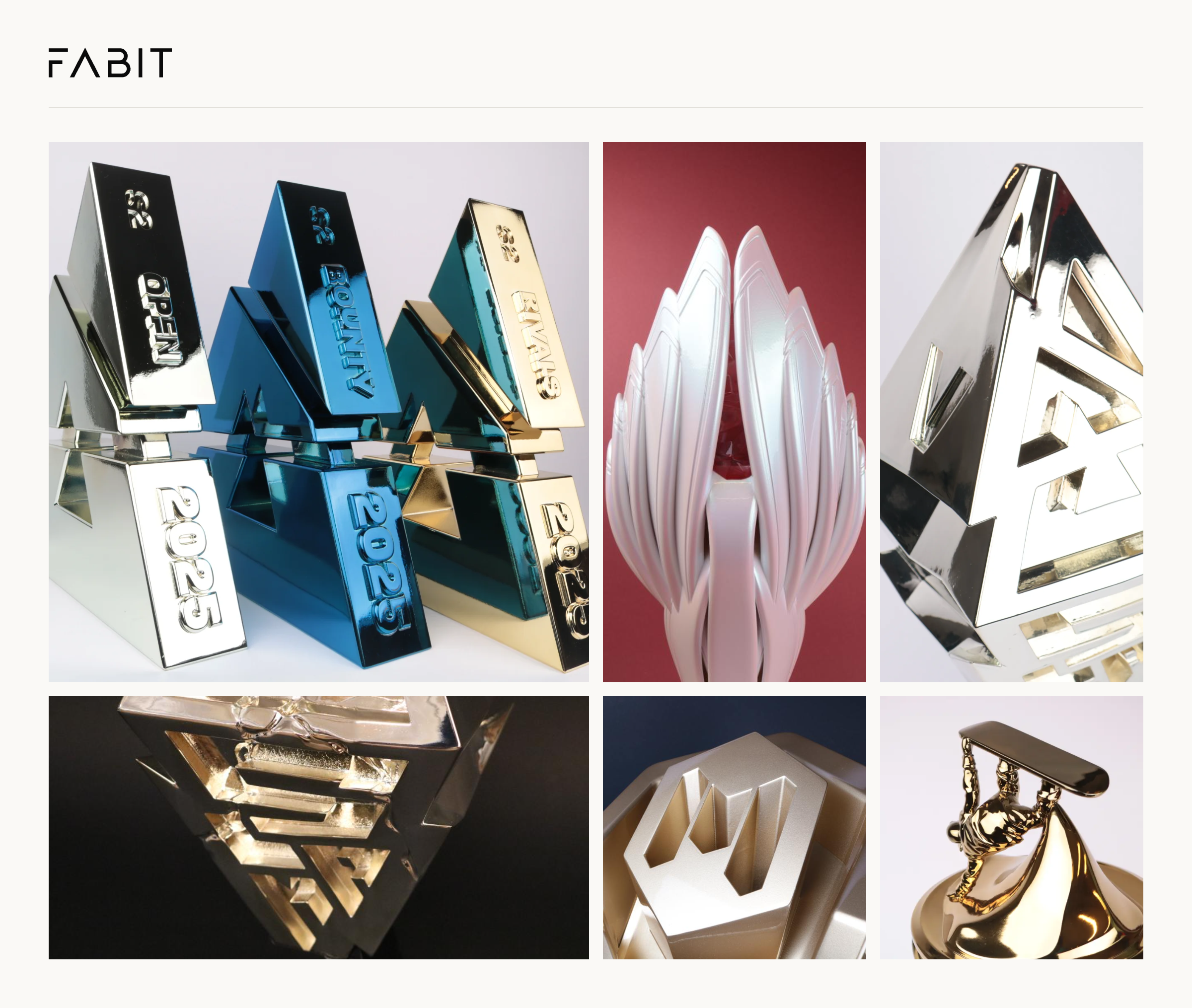
Bead blasting can be applied selectively by masking certain areas, allowing polished and matte regions to sit side by side on the same piece. This technique creates striking contrasts, a mirror polished logo against a bead blasted ground, for instance, or a matte body with polished edges. The clean, non directional nature of the blasted areas makes these contrasts especially crisp and controlled. Combined with engraving, where the cut detail reveals brighter metal against the matte surround, selective blasting offers rich design possibilities.
Bead blasting and 3D printed parts
Bead blasting is also an excellent post processing step for 3D printed components, whether in metal or certain plastics. It evens out subtle surface texture from the printing process and creates a consistent matte that unifies the appearance of complex geometries. For clients exploring our 3D printed trophy options, bead blasting can be the finishing touch that gives a digitally produced form a refined, cohesive surface.
Durability and care
A bead blasted finish is practical and forgiving. Its uniform texture disguises fingerprints and light scuffs far better than a polished surface, and its even matte appearance is easy to maintain. Should the surface become marked over time, it can often be refreshed by reblasting. For everyday care, a soft cloth is all that is required. When protected with a coating such as PVD, DLC, or anodising, a bead blasted surface becomes even more durable and resistant to the environment.
Bead blasting compared with brushing
Clients often weigh bead blasting against a brushed finish. Both create satin matte surfaces, but the key difference is directionality. Brushing produces visible parallel lines with a grain direction that changes appearance with viewing angle, while bead blasting is uniform and non directional. Brushing can feel more industrial or architectural, whereas blasting feels softer and more uniform. Neither is superior; the right choice depends on the design intent. For clean, sculptural forms we often favour blasting, while brushing can suit pieces where a sense of grain and direction is desirable.
Frequently asked questions
Is bead blasting the same as sandblasting? They are related, but bead blasting uses round glass beads that peen the surface gently, producing a finer, softer matte than the angular media used in coarser sandblasting.
Can bead blasted surfaces be coloured? Yes. PVD, DLC, and anodising applied over a blasted base produce even matte coloured finishes that retain the underlying texture.
Does bead blasting hide fingerprints? Very well. The uniform matte texture disguises fingerprints and minor marks far better than polished surfaces.
How do I request a bead blasted award? Start through our design tool. We respond within 24 hours and ship worldwide.
Related terms