CNC machining is a subtractive manufacturing process in which computer-controlled cutting tools remove material from a solid block to carve out a precise finished part, working directly from a digital design. Where 3D printing adds material, CNC machining takes it away, and the two are natural partners in high-end award making. At Fabit, CNC machining complements our in-house additive manufacturing, giving us crisp machined metal bases, plates and components to pair with printed and cast elements in premium bespoke trophies.
How CNC machining works
CNC stands for Computer Numerical Control. A digital model is translated into a set of coordinated tool movements, and a machine, such as a mill or a lathe, drives cutting tools along multiple axes to remove material from a solid workpiece. A milling machine spins a cutter and moves it across a fixed block, while a lathe spins the workpiece against a stationary tool. Advanced machines work in three, four or five axes, letting the tool approach the material from many angles to produce complex contoured surfaces.
Because the geometry comes from the digital file and the machine is extraordinarily repeatable, CNC parts are dimensionally accurate to fine tolerances and share an identical result across a whole batch. The trade-off is that a tool must be able to physically reach every surface, so fully enclosed internal geometry is not possible the way it is in printing.
Subtractive versus additive
CNC machining and 3D printing are opposite philosophies that solve different problems:
- CNC machining delivers superb precision, excellent surface finish on metals, and material properties identical to the solid stock, but cannot reach enclosed cavities and wastes the material it cuts away.
- 3D printing builds complex, hollow and organic geometry with no tooling and minimal waste, but has its own surface and material characteristics.
The insight that defines Fabit’s craft is that these are not competitors. A single award often wants both: a flawlessly machined solid metal base for weight and precision, topped by a 3D printed or cast element for complex bespoke form.
What CNC machining does best for awards
CNC machining is the master of clean, precise, solid forms. It produces beautifully flat and square metal bases, perfectly cylindrical columns, engraved plates with crisp edges, and machined details with a fine surface straight off the tool. For an award, this precision reads as quality: a base that sits perfectly level, edges that are exactly true, and a machined sheen that only subtractive metalworking gives. It is also excellent for functional features like threaded holes and mounting points that join components together.
Materials for CNC machining
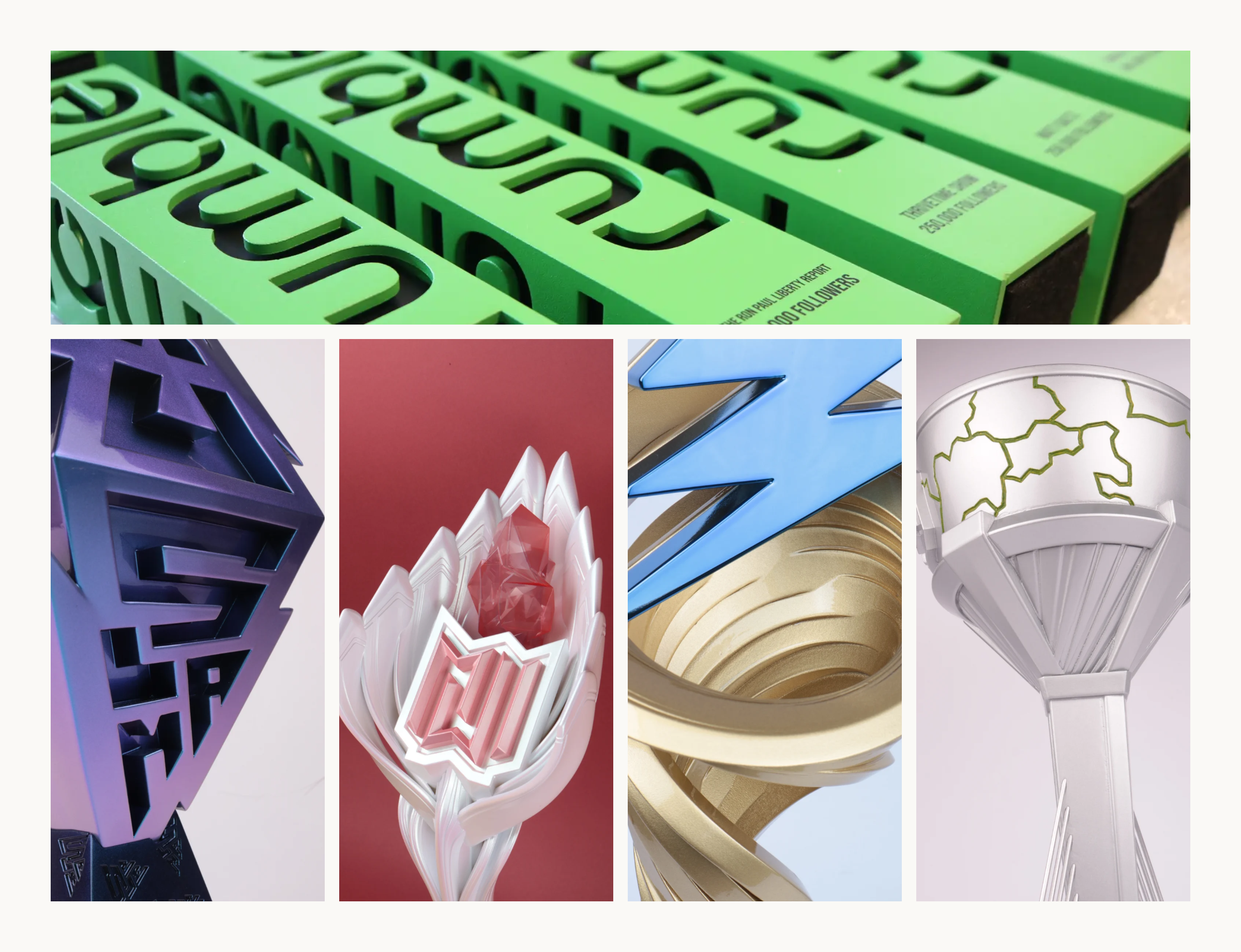
CNC machines cut an enormous range of solid materials, and each suits different award elements. Aluminium is light, easy to machine and takes anodising in vivid colours. Stainless steel and brass give weight and a premium metallic finish. Solid acrylic and other plastics can be machined for clear or coloured components. Wood can be machined for warm, natural bases. This breadth lets Fabit choose the ideal machined material for each part of a piece, then integrate it with printed and cast elements.
Finishing machined parts
Machined parts arrive with a fine surface but still benefit from finishing craft. Metal can be bead blasted for a uniform matte, brushed for a satin grain, polished to a mirror, or anodised and plated for colour and protection. Edges are deburred, surfaces are cleaned, and engraving or colour fills are added. Because Fabit finishes in-house, machined bases and printed tops are treated as one coherent object, finished to match, rather than mismatched parts from different suppliers.
CNC machining in Fabit’s workflow
CNC machining sits within Fabit’s integrated capability alongside SLA, SLS and metal printing and investment casting. This lets us design an award as a whole and choose, element by element, whether it is best printed, cast or machined, then assemble and finish it under one roof in Antwerp before worldwide shipping, always with a 24-hour response. To see how machined and printed elements combine, explore our materials overview, browse finished pieces on our 3D printed trophy page, or start designing in our online studio.
Frequently asked questions
How is CNC machining different from 3D printing? CNC machining removes material from a solid block to reveal a part, while 3D printing adds material layer by layer. They suit opposite kinds of geometry and are often used together.
What is CNC machining best for in awards? Precise, solid components such as flat metal bases, columns, engraved plates and mounting features, where accuracy and a fine metal finish matter.
What materials can be CNC machined? Metals like aluminium, stainless steel and brass, plus acrylic, other plastics and wood, giving broad choice for different award elements.
Does Fabit combine machining with printing? Yes. Fabit routinely pairs a machined solid base with a 3D printed or cast top, finishing the whole piece in-house so it reads as one object.
Related terms