Metal injection molding, commonly abbreviated as MIM, is a manufacturing process that blends fine metal powder with a polymer binder to form a feedstock, injects it into a mould like plastic, then removes the binder and sinters the part to produce a small, complex, dense metal component. It marries the shape making freedom of plastic injection molding with the material properties of metal. Understanding MIM enriches the perspective Fabit brings to award production, because it illustrates the trade offs between tooling based volume manufacturing and the tooling free, individualised freedom that defines our 3D printed craft.
How metal injection molding works
MIM proceeds through four distinct stages. First, very fine metal powder is mixed with a thermoplastic binder to create a feedstock with a consistency that flows when heated. Second, this feedstock is injected into a mould under pressure, exactly as molten plastic would be, filling every detail of the cavity to produce what is called a green part. Third, the binder is removed through a debinding step, using heat, solvent, or catalytic methods, leaving a fragile, porous brown part held together only by the metal skeleton. Fourth, the part is sintered in a furnace, where the metal particles fuse and densify into a solid metal component.
As with all sintering based routes, the part shrinks significantly during the furnace step, often by a substantial fraction, so the mould must be designed oversized to compensate. Predicting that shrinkage precisely is one of the demanding skills of MIM.
What metal injection molding is good at
MIM excels at producing small, intricate metal parts in high volumes. Once the mould is made, each cycle produces a part quickly and consistently, so unit costs fall sharply as quantities rise. It handles complex geometries that would be costly to machine, and it achieves good density and mechanical properties after sintering. Industries such as medical devices, firearms, consumer electronics, and automotive components rely on MIM for exactly these reasons, small metal parts, made accurately, in large numbers.
The economics are the crux. MIM rewards volume because the cost of the mould is spread across many identical parts. It is a mass production technology at heart.
Why MIM is not our route for bespoke awards
Here lies the essential contrast with Fabit’s craft. MIM requires a mould, and a mould means tooling cost, tooling lead time, and identical parts. For a bespoke, personalised, or one off award, that model works against us. Every recognition piece we make can be unique, carrying different names, dates, or forms, and 3D printing delivers that individuality with no tooling at all. Where MIM would demand a new mould for every variation, additive manufacturing simply reads a new file. For the personalised, low volume, high value pieces our clients commission, tooling free printing is decisively the better path. We explain this openly, because guiding clients to the right process is central to our advice on every custom trophy commission.
Metal injection molding compared with 3D printing
- Tooling: MIM needs a mould, while 3D printing needs none, so printing suits personalisation and one offs.
- Volume: MIM rewards high volumes, while printing is efficient at any quantity, including a single piece.
- Lead time: MIM tooling takes time to make, while printing starts from a file immediately.
- Geometry: both handle complexity, but printing enables internal structures a mould cannot release.
- Density: MIM reaches density through sintering, while melting based printing reaches it in a single build.
Where MIM and additive share DNA
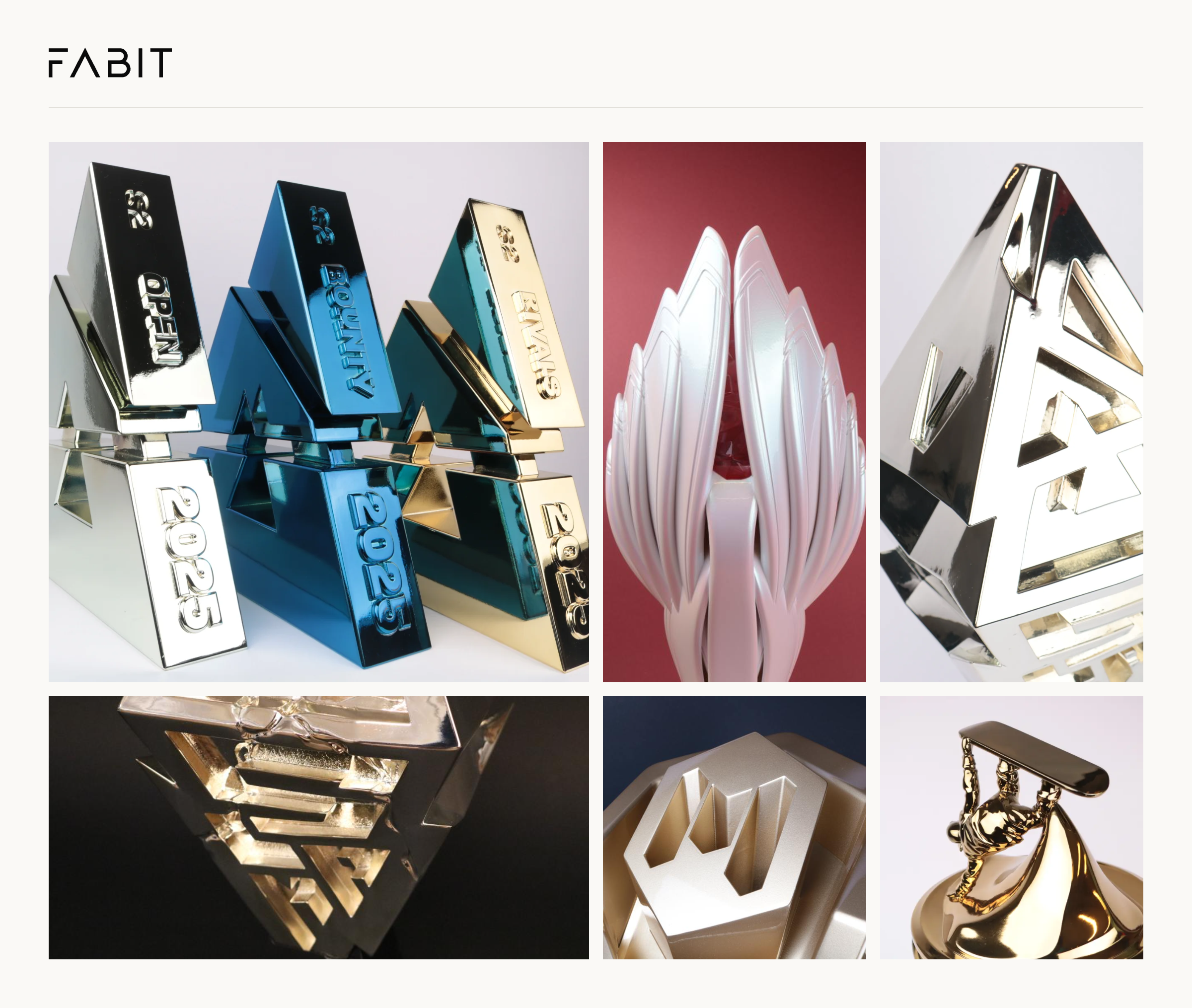
MIM and certain additive processes share metallurgical roots, since both can rely on sintering to reach final density, and both begin with fine metal powder. Binder jetting in particular resembles MIM in that a green part is later densified in a furnace. Understanding this shared chemistry helps us reason clearly about surface finish, shrinkage, and mechanical properties across processes. It also underlines why, for the crispest detail and most reliable density in a one off award, we favour fully melting powder bed fusion, which reaches density directly. The metals we bring to life are shown on our materials overview.
How Fabit applies this understanding
Fabit is a craft led studio producing genuine metal awards to a museum standard, built for individuality rather than mass sameness. Metal injection molding is a superb technology for its purpose, high volume small parts, but it is not the tool for bespoke recognition pieces. Understanding it, alongside sintering, binder jetting, and powder bed fusion, lets us advise clients with complete honesty and choose the right route every time. Because our production is coordinated in house in Antwerp, we control quality end to end, respond within twenty four hours, and deliver finished pieces worldwide.
Starting your project
If you want an award that is truly yours, personalised, distinctive, and made without the constraints of tooling, 3D printing is almost always the answer, and our team will guide you through it. To begin shaping your concept today, open our online create tool and start the conversation.
Frequently asked questions
Is MIM good for custom trophies? Not really. MIM needs a mould and rewards high volumes of identical parts, so for personalised, low volume awards we use tooling free 3D printing instead.
Does MIM produce solid metal parts? Yes, after sintering the parts are dense metal, though they shrink significantly during that furnace step.
Why does MIM need such high volumes? The mould is expensive, so its cost only makes sense when spread across many identical parts.
How is MIM like binder jetting? Both create a green part that is later densified by sintering, sharing powder metallurgy roots.
Metal injection molding is a masterful volume technology, and understanding exactly where it belongs is what lets us steer every bespoke award toward the tooling free, individualised craft that makes a Fabit piece unmistakably its own.
Related terms