Fiber laser engraving is a marking method that uses a concentrated beam from a fiber optic laser source to alter the surface of metal, producing permanent, high contrast text, logos and artwork without any physical contact or consumable ink. For high-end custom trophies and awards, it is the finishing technique that most reliably turns a raw metal blank into a piece that reads as considered and enduring. At Fabit, fiber laser engraving is one of the in-house craft processes we reach for when a client wants a mark that will still look crisp decades after the ceremony.
What fiber laser engraving actually is
A fiber laser generates its beam inside an optical fiber doped with rare earth elements, most commonly ytterbium. That beam operates in a wavelength band, around 1064 nanometres, that metals absorb efficiently. When the focused beam meets the surface, it delivers energy fast enough to melt, vaporise or oxidise a microscopically thin layer, leaving a mark that is part of the material rather than a coating sitting on top of it. Because the process is non-contact, there is no tool pressure to distort thin walls or delicate edges, which matters when you are working with the slender forms that premium awards often demand.
The result you see depends on how the beam is controlled. Lower power with rapid passes anneals the surface and produces a dark, smooth mark on stainless steel with no depth change at all. Higher power removes material and creates a tactile, recessed engraving you can feel with a fingertip. This range is what makes the technique so versatile for award work.
Which materials respond best
Fiber lasers are built for metal. Stainless steel, aluminium, brass, titanium, anodised finishes and many coated metals all mark cleanly. The technique is a natural partner to the metal blanks and plates we describe on our materials overview, where the interaction between alloy and beam determines the final look.
- Stainless steel: annealing produces a deep black mark with no engraving depth, ideal for elegant logos.
- Anodised aluminium: the beam removes the coloured oxide layer to reveal bright silver beneath, giving strong contrast.
- Brass and bronze: engraving cuts into the surface for a classic, dimensional plaque look.
- Titanium: controlled oxidation can create colour effects alongside standard marking.
- Coated metals: the coating is ablated to expose the substrate, a technique often used for two-tone results.
Why it suits high-end awards
Permanence is the headline benefit. A fiber laser mark does not fade, peel, smudge or oxidise the way printed or adhesive labels can. For an award that represents a career milestone or a landmark deal, that permanence is the entire point. The second benefit is resolution. The focused spot is small enough to reproduce fine serifs, hairline rules and intricate emblems that would clog with ink or blur with a coarser process. The third is consistency. Digital control means the tenth piece in a run is identical to the first, which is essential when you are producing a tiered set of awards for a single event.
The design and preparation stage
Good engraving begins with good artwork. Vector files give the cleanest edges because the laser follows precise paths rather than interpreting a grid of pixels. Logos with very thin strokes or subtle tonal gradients need review before production, since a gradient has to be translated into a dithered pattern of dots on metal. Our team advises on these details during quoting so there are no surprises at the ceremony. If you want to begin visualising a piece, our design studio is the natural starting point for shaping a concept before we translate it to the laser bed.
Fiber laser versus other marking methods
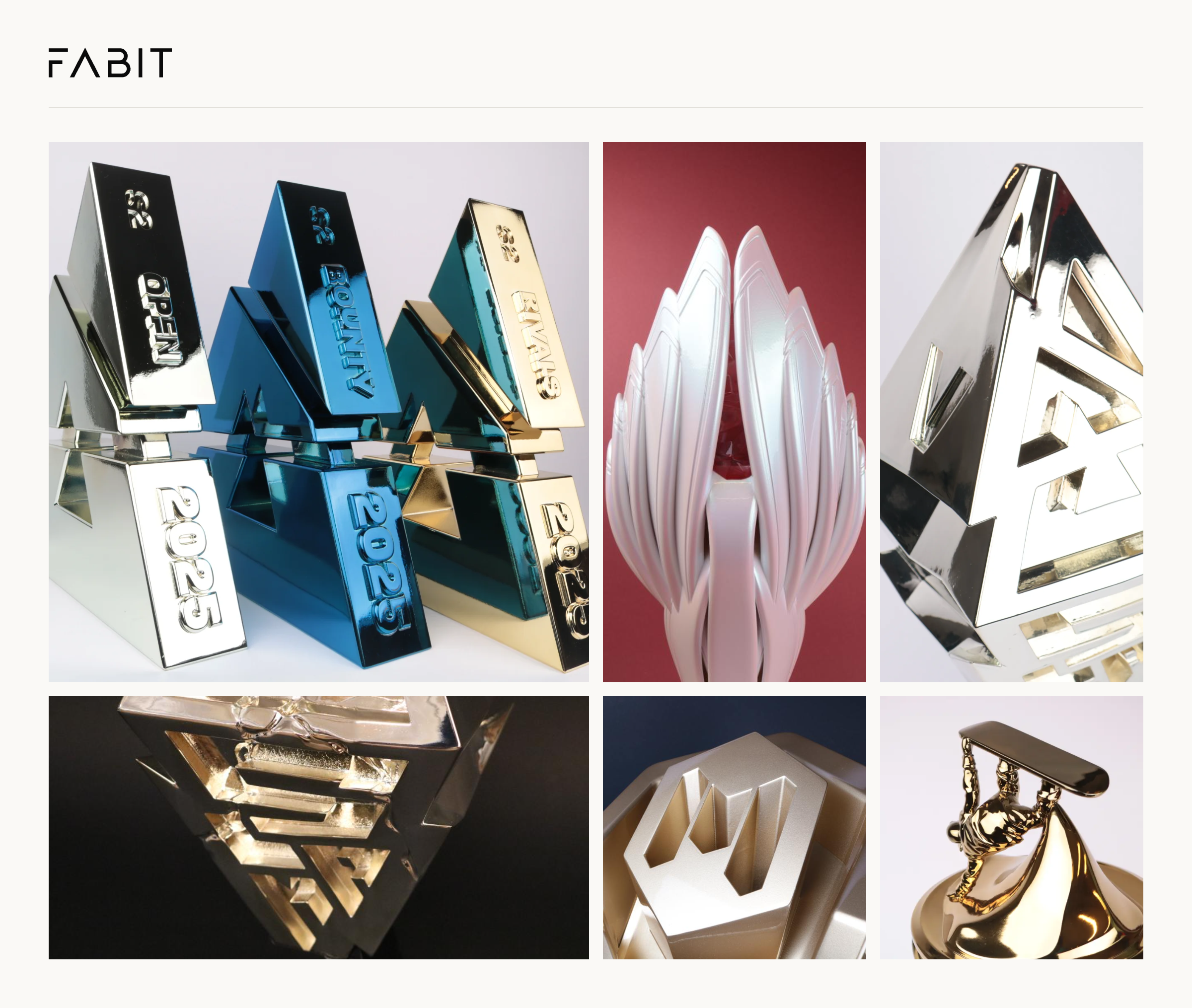
Compared with CO2 lasers, fiber lasers are far more efficient on bare metal because the wavelength is absorbed rather than reflected. Compared with diamond drag engraving, fiber marking is faster, needs no cutting stylus and can render halftone imagery, not just line work. Compared with printing, it offers unmatched durability at the cost of full colour. Many of the finest awards combine methods, and you can see how these finishes come together across our custom trophies service.
Quality, tolerances and finishing
After engraving, pieces are cleaned to remove any residue and inspected under raking light, which reveals inconsistencies that flat lighting hides. On annealed stainless we check that the black is uniform and free of the brownish halo that signals incorrect settings. On engraved brass we confirm the depth is even and the edges are sharp. This inspection discipline is part of why our marks hold their value over time.
Practical considerations for buyers
Lead time for fiber engraving itself is short, often a matter of minutes per piece once the file is set, so the schedule is usually driven by the trophy body rather than the marking. Personalisation such as individual names is easy to add late in the process, which is helpful when winners are confirmed close to an event date. Because we respond to enquiries within 24 hours and produce in-house, last minute changes are rarely a problem.
Frequently asked questions
Does fiber laser engraving damage thin or hollow awards? No. The process is non-contact, so there is no mechanical pressure. Heat is highly localised, which protects delicate geometry.
Can you engrave photographs onto metal? Yes, within limits. Continuous tone images are converted to a fine dither pattern. The result is striking on the right alloy, and we review each image before committing it to production.
Will the mark wear off with handling? A properly executed fiber mark is integral to the metal and will outlast the occasion it commemorates. Annealed marks sit at the surface but remain highly resistant to abrasion.
Can names be added after the main run is made? Absolutely. Late personalisation is one of the strengths of laser marking, and we routinely engrave winner names once a list is finalised.
Fiber laser engraving is, in short, the quiet workhorse behind many of the most refined metal awards we produce. It rewards careful artwork with permanence, precision and a finish that feels intentional in the hand.
Related terms