UV printing is a digital printing method that jets ink directly onto a surface and cures it instantly with ultraviolet light, producing vivid, full colour graphics on almost any material, including a raised, textured effect where desired. Its extraordinary versatility across materials makes it one of the most useful finishing tools in modern award making. At Fabit, UV printing lets us apply full colour artwork, and even tactile relief, to surfaces that other printing methods cannot handle, from glass and acrylic to metal, wood and coated composites.
How UV printing works
A UV printer works much like a desktop inkjet, but with two crucial differences. First, the inks are formulated to cure under ultraviolet light rather than by drying through evaporation. Second, as the ink is laid down, ultraviolet lamps immediately harden it, so it sets the instant it touches the surface. This instant curing means the ink does not soak in or spread, which allows sharp detail and vivid colour on non absorbent materials like glass and metal. It also means the ink builds a very slight physical layer, and by printing multiple passes that layer can be built up deliberately into a raised, tactile texture.
Because it is a digital process, UV printing needs no plates or screens. Each piece prints straight from the artwork file, and full colour, gradients and fine detail all reproduce in a single pass.
Materials UV printing can handle
Versatility is the defining feature. UV printing adheres to a remarkably broad range of surfaces, which pairs well with the diversity of materials on our materials overview.
- Acrylic: vivid colour with the option of printing on the reverse.
- Glass and crystal: full colour graphics that would be impossible to engrave in colour.
- Metal: including bare and anodised surfaces, without a special coating.
- Wood: colour graphics over a natural grain.
- Composites and 3D printed parts: useful for contemporary and bespoke forms.
Why UV printing suits premium awards
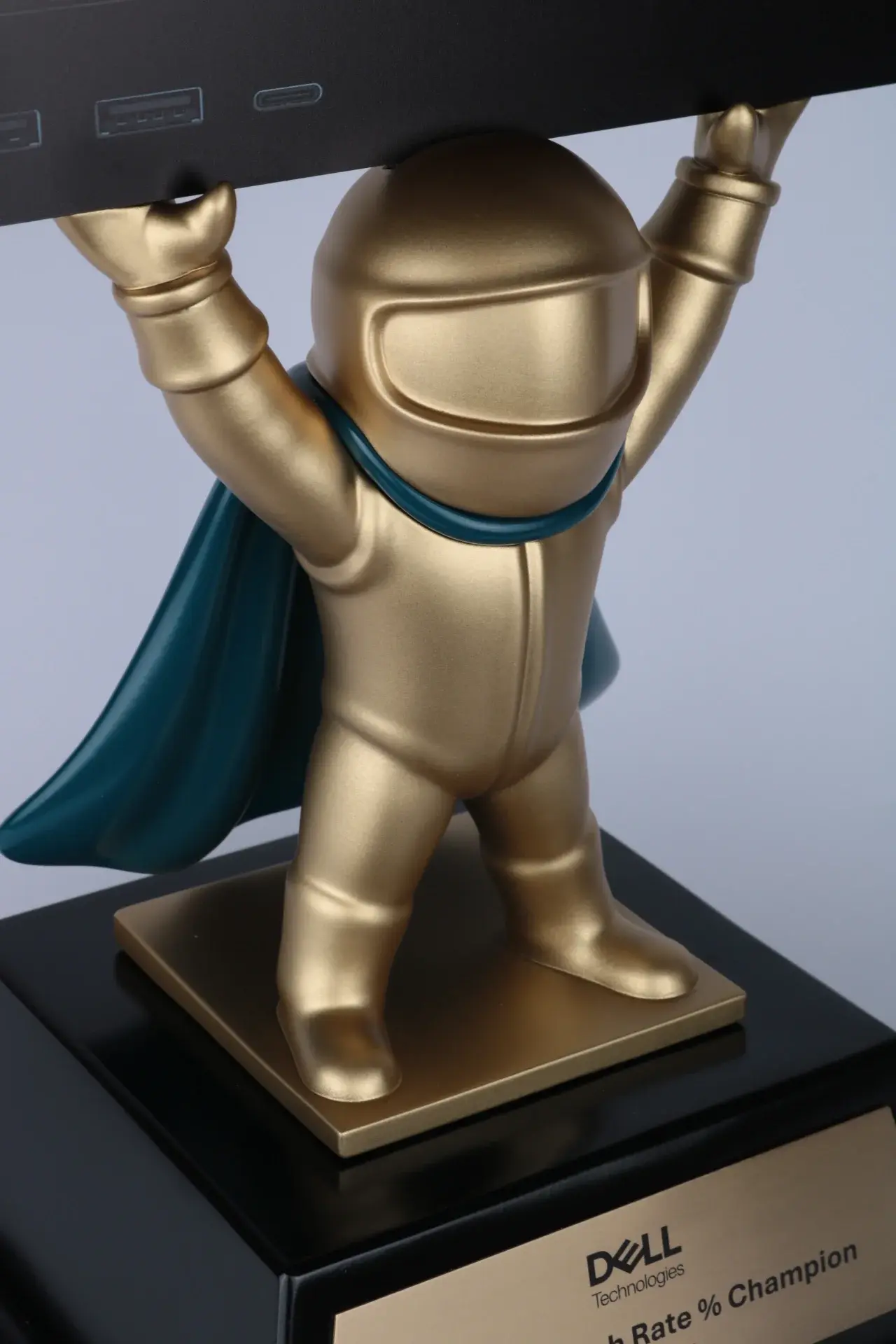
The great advantage of UV printing is that it removes the material barrier. If a designer wants a full colour brand mark on a crystal award, a photographic panel on a wooden base, or a coloured graphic on a bare metal face, UV printing makes it possible without the coating that sublimation requires. That freedom lets us match a finishing method to the ideal material rather than compromising the material to suit the finish. The optional raised texture also adds a tactile, premium dimension, letting a logo be felt as well as seen. For awards built on our 3D printed trophy forms, UV printing is especially valuable because it colours complex printed geometry directly.
Design considerations
UV printing handles full colour artwork, gradients and photographic detail comfortably. For coloured graphics on dark or transparent materials, a white ink underbase can be printed first so the colours read accurately, which is a distinct advantage over methods that rely on a light substrate. When a tactile finish is wanted, the artwork is set up in layers so the printer can build height in the chosen areas. We manage these technical decisions on our side, and clients can develop and preview colourful artwork in our design studio before production.
UV printing versus other methods
Against sublimation printing, UV prints on a far wider range of materials, including uncoated ones, and can add texture, though sublimation gives a smoother, fully embedded result on coated panels. Against screen and pad printing, UV handles full colour and photographic detail in a single digital pass without plates. Against engraving, it brings colour and imagery that no beam can add. Many refined awards combine UV printed colour with engraved or etched detail, an approach we coordinate within our custom trophies service.
Durability and finishing
Cured UV ink is hard wearing and resistant to scratching and fading, particularly on rigid surfaces. Because the ink sits on the surface rather than being embedded, adhesion depends on correct surface preparation, which is why we clean and, where needed, prime surfaces before printing. On some materials an additional clear coat can further protect the print. Each finished piece is inspected for colour accuracy, sharp registration and, where texture is used, for consistent build height across the design.
Practical notes for buyers
Being fully digital, UV printing is economical for both single awards and short runs, and it handles personalisation effortlessly since every piece prints from its own file. There are no plates or screens to prepare, so changing artwork between pieces carries no penalty. Our in-house workshop and 24-hour response make UV printing a dependable choice for colourful, individually customised awards on tight timelines.
Frequently asked questions
Can UV printing put colour on clear glass or acrylic? Yes. With a white underbase, full colour graphics read accurately even on transparent or dark surfaces.
Does the print feel raised? It can. By building multiple ink layers, UV printing can create a deliberate tactile texture, or stay flat if a smooth finish is preferred.
Is UV printing durable on metal? Yes, with proper surface preparation. An optional clear coat can add further protection on high wear pieces.
Can it print on 3D printed trophy parts? Yes. UV printing colours complex printed geometry directly, which makes it ideal for contemporary bespoke forms.
UV printing is the great enabler of colour in modern award making, bringing vivid, durable and even tactile graphics to almost any surface without forcing a compromise on the material a designer truly wants.
Related terms