Hand engraving is the artisan craft of cutting designs, lettering and ornament directly into metal using hand held gravers, guided entirely by the skill and judgement of the engraver rather than by a machine or beam. It is the most personal and the most demanding of all finishing techniques, and it occupies a special place in high-end award making. At Fabit, hand engraving is reserved for pieces where a client wants something genuinely singular, where the trace of a human hand is part of the value rather than an imperfection to be eliminated.
What hand engraving involves
The engraver uses a graver, a small hardened steel tool sharpened to a precise geometry, to remove slivers of metal along the lines of a design. The cut is driven either by hand pressure, by a small mallet in the traditional manner, or by a pneumatic handpiece that delivers rapid controlled impacts. As the graver moves, it lifts a curl of metal and leaves behind a bright, faceted line whose brilliance comes from the mirror smooth walls the tool creates. Depth, angle and width are all modulated by the engraver in real time, which is what allows hand work to carry a life and variation that machine methods cannot reproduce.
Because every cut reflects a human decision, no two hand engraved pieces are ever truly identical, even when they follow the same design. That individuality is precisely the point for the collectors and organisations who commission this work. The engraver also controls the way light will eventually play across the finished piece, since the angle of each facet determines how it catches and throws light. A skilled hand will vary the cut so that a flourish appears to swell and taper, or so that a monogram seems to lift from the surface. This is drawing in metal, with the graver behaving less like a machine tool and more like a pen in the hand of an artist. The tradition reaches back centuries, from armour and silverware to fine firearms and presentation pieces, and commissioning hand engraving today places an award within that long lineage of craft rather than within the world of mass production.
Materials and where hand engraving shines
Hand engraving is traditionally practised on precious and soft metals, though a skilled engraver can work a range of surfaces. It complements the fine metal components described on our materials overview.
- Silver and gold: the classic canvases, taking a brilliant, deep cut.
- Brass and bronze: warm tones that suit ornamental and heraldic work.
- Pewter and soft alloys: forgiving surfaces for flowing script.
- Copper: a soft metal that holds fine detail well.
- Selected steels: possible for experienced hands where durability is paramount.
Why hand engraving belongs on the finest awards
When an award marks a truly exceptional achievement, a lifetime honour, a founding contribution, a once in a generation moment, machine perfection can feel oddly impersonal. Hand engraving restores the human element. The subtle variation in a hand cut line, the confident sweep of a flourish, the depth of a monogram, all communicate that a person invested time and skill in this specific object. That message is impossible to mass produce, and it is why hand engraving carries a prestige that no automated process can match.
The design and collaboration process
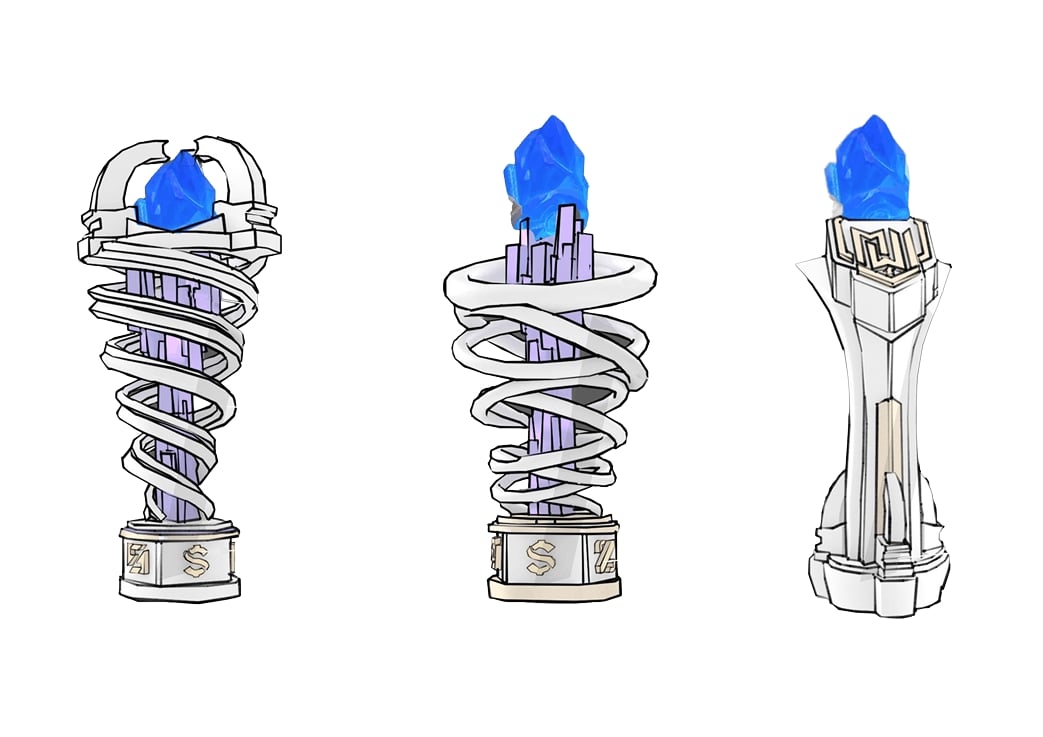
Hand engraving begins with drawing. An engraver typically works from detailed artwork or from sketches developed with the client, refining ornament, lettering style and layout before any metal is touched. This collaborative stage is essential, since the design must be resolved fully before cutting begins. We often start from concept sketches and build toward a final layout, and our design studio supports that early exploration before a piece is handed to the engraver. For clients commissioning a complete bespoke award, this work sits within our wider custom trophies service.
Hand engraving versus machine methods
Against diamond drag and laser engraving, hand engraving trades speed and repeatability for artistry and individuality. A machine will always be faster and more consistent, which is ideal for a run of identical awards. Hand engraving is the opposite proposition. It is slower, more expensive and utterly unique, which is exactly why it is chosen for the single most important piece rather than a large series. The two approaches are not rivals so much as tools for different occasions.
Time, skill and cost
It is worth being candid that hand engraving is a considered investment. A skilled engraver may spend hours or days on an intricate piece, and that time is reflected in the price. The skill involved takes years to develop, and the supply of true master engravers is limited. Clients commissioning hand work are paying for rare human expertise, not just material and machine time, and the resulting object reflects that.
Quality and longevity
A well executed hand engraving is astonishingly durable. Cut deep into solid metal, it will survive generations of handling and display. Because the cut walls are polished by the graver itself, the brilliance of the line endures rather than dulling. Each finished piece is inspected closely, though in hand work the goal is not machine uniformity but a confident, coherent whole that reads as intentional craft.
Frequently asked questions
Is hand engraving worth the extra cost? For a truly significant, one off award, yes. It offers individuality and prestige that no machine method can replicate.
How long does a hand engraved piece take? It depends entirely on complexity, from several hours to several days. We advise realistic timelines at the quoting stage.
Can hand engraving be combined with other methods? Yes. A hand engraved centrepiece paired with machine marked supporting elements is a common and effective approach.
Will small variations show in the finished piece? Subtle variation is inherent to hand work and is part of its character and value, not a flaw.
Hand engraving is the pinnacle of the finishing crafts, the choice for the rare occasion when an award must carry not only a name but the unmistakable evidence of human skill.
Related terms