Borosilicate glass is an exceptionally clear, thermally stable glass made with boron trioxide, valued in premium award making for its optical purity, resistance to thermal shock, and the freedom it gives skilled makers to blow and sculpt ambitious forms. It is the same family of glass used in laboratory apparatus and fine cookware, which is precisely why it behaves so well under the heat of the flame and the demands of hand-shaping.
What makes borosilicate glass different
Ordinary soda-lime glass, the everyday glass of bottles and windows, expands and contracts significantly with temperature. Borosilicate glass replaces some of that composition with boron trioxide, dramatically lowering its coefficient of thermal expansion. In practical terms this means it tolerates rapid heating and cooling without cracking, which is essential when a maker is working molten glass at the torch or in the furnace. That same stability translates into a finished award that is robust and dimensionally precise.
There is also an optical benefit that matters for awards specifically. Borosilicate tends to have very low levels of impurities and a subtle, neutral character that lets it read as genuinely clean rather than faintly tinted. When a design calls for an object that appears almost like solid light, with engraving or an internal element seeming to float in nothing, this purity is exactly what sells the effect. The material effectively disappears and leaves only the form and the message, which is a powerful quality for a recognition piece that should feel considered and precise.
Why it suits high-end awards
For recognition pieces, borosilicate offers a combination that is hard to beat. It is optically clean, with excellent light transmission and minimal colour cast, so it reads as pure and modern. It is strong, resisting the small knocks a treasured object endures over years. And because it can be flame-worked, it enables the sweeping curves, internal bubbles, and layered effects that distinguish a bespoke sculpture from a mass-produced blank.
- Clarity: high transparency shows off engraving and internal detail.
- Thermal resilience: stable under the heat of hand-working.
- Strength: more resistant to thermal and mechanical stress than standard glass.
- Design freedom: ideal for sculptural, flowing, and layered forms.
- Longevity: holds clarity and finish for decades.
How Fabit works borosilicate glass
In a bespoke studio setting, borosilicate is most often flame-worked or kiln-formed to a brief. A concept sketch becomes a three-dimensional object through torch work, shaping, annealing, and finishing. Because the material is forgiving under heat, makers can pursue detail that would risk cracking in less stable glass. The result can then be engraved, sandblasted, or paired with metal, wood, or printed elements to complete the design. Our custom trophies service takes clients from first sketch to finished piece.
Annealing and why it matters
After shaping, glass must be cooled slowly in a controlled process called annealing. This relieves internal stresses that would otherwise leave the piece fragile or prone to sudden failure. Borosilicate’s low expansion makes it more tolerant during this stage, but proper annealing remains essential to a durable award. A reputable maker will always anneal correctly, and this is one of the quiet marks of quality that separates a considered piece from a rushed one.
Design considerations
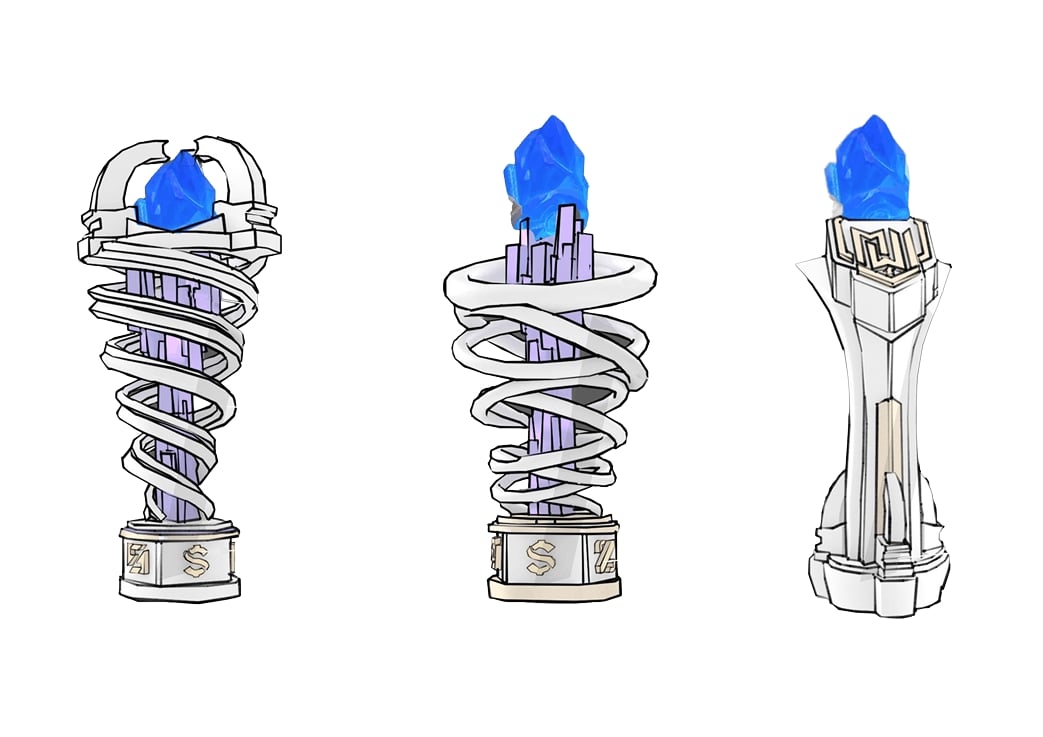
Borosilicate rewards ambitious geometry, so it is a natural choice when a client wants something sculptural rather than a simple slab. Consider how light will move through the form, where engraving or artwork will sit, and how the piece will stand. Because it is clear, it also pairs beautifully with a coloured base, a metal plinth, or an internal element that appears to float. If the brief calls for a bold tint throughout, coloured art glass or jade glass may be more appropriate, and our team will advise on the best fit.
Scale and stability are also worth planning early. A tall, slender sculptural form is visually striking but needs a considered centre of gravity and, often, a weighted or broadened base so it stands securely on a shelf or presentation table. Equally, the point where the piece will be gripped during an on-stage handover should feel natural and safe. These are the kinds of practical details that separate an award that merely looks good in a photograph from one that performs beautifully in the moment it is presented, and they are exactly the considerations our advisory process is built to catch before production begins.
Care and durability
Borosilicate awards are low-maintenance. Clean with a soft cloth and mild glass cleaner, handle by the body rather than delicate extremities, and store away from hard impacts. The material will not yellow or cloud over time, and its finish remains as crisp as the day it was made. For pieces that will be displayed under lighting or on camera, this enduring clarity is a lasting advantage.
Specifying borosilicate glass with Fabit
Because every Fabit piece is designed around the client rather than pulled from a shelf, borosilicate can be shaped and combined to match a precise vision. Clients usually begin with a reference or concept, and our advisors return form options, finishing methods, and decoration recommendations quickly. Start a concept in our online design studio or review the wider palette on our materials overview.
Frequently asked questions
Is borosilicate glass stronger than normal glass? It is more resistant to thermal shock and generally more robust than standard soda-lime glass, though it is still glass and should be handled with care.
Can borosilicate be coloured? Yes. Coloured rods and powders can be introduced during flame-working to add accents or full colour while keeping the material’s clarity elsewhere.
Is it suitable for engraving? Absolutely. It accepts laser engraving, subsurface engraving, and sandblasting, all of which show cleanly against its clear body.
Why choose borosilicate over crystal? Choose it when you want sculptural, hand-worked forms and thermal robustness. Crystal is often selected for heavy cast blanks and a particular weight in the hand.
Related terms