NURBS, short for Non Uniform Rational B Splines, are a mathematical way of describing perfectly smooth curves and surfaces, which makes them the natural choice for the flawless, flowing forms that high end trophies and awards depend on. Where a mesh approximates a curve with many tiny flat faces, a NURBS surface is truly smooth at any scale, and that difference is exactly what separates a premium award that catches light beautifully from one that looks faceted and cheap.
What NURBS are and why they feel so smooth
A NURBS surface is defined by control points and mathematical curves rather than by a grid of triangles. Because the surface is calculated from equations, it stays perfectly smooth no matter how closely you look or how large you print it. There is no point at which the curve breaks into visible facets. For an object whose entire job is to feel refined and to reflect light cleanly, this mathematical smoothness is not a luxury, it is the foundation.
Control points act like gentle magnets. Moving one nudges the surface toward it, and the curve responds in a fluid, continuous way. This gives a designer sensitive, intuitive control over sweeping shapes, which is precisely what an elegant award silhouette requires.
Why premium awards live and die on curve quality
Light is the honest critic of any trophy. When a surface is truly smooth, reflections travel across it in unbroken, graceful bands. When a surface is subtly faceted, reflections fracture and the eye reads the object as lower quality, even if the viewer cannot say why. NURBS surfaces produce what designers call clean continuity, meaning curves flow into one another without visible seams or kinks. On a polished metal or crystalline resin award, that continuity is the whole game. Explore how different materials interact with light and you quickly see why surface quality matters so much.
NURBS versus mesh: choosing the right tool
Meshes are excellent for organic, sculpted, highly detailed forms. NURBS are excellent for precise, engineered, flowing surfaces. A great award studio uses both. A trophy with clean, architectural curves and mirror smooth faces is a NURBS job. A trophy featuring a rugged, hand sculpted figure or intricate organic texture may lean on mesh based digital sculpting. Often a single piece combines the two: a NURBS body carrying a sculpted emblem. Knowing which tool serves which part of the design is a core craft skill.
Continuity: the invisible mark of quality
Designers talk about levels of continuity between surfaces. Position continuity means two surfaces simply touch. Tangency means they meet without a visible crease. Curvature continuity means they flow together so seamlessly that reflections glide across the join undisturbed. The finest awards are built to curvature continuity wherever the eye travels. Achieving this by hand is painstaking; NURBS make it controllable and repeatable, which is why they are trusted for pieces that must look immaculate under gallery lighting and in close up photography.
From NURBS surface to solid award
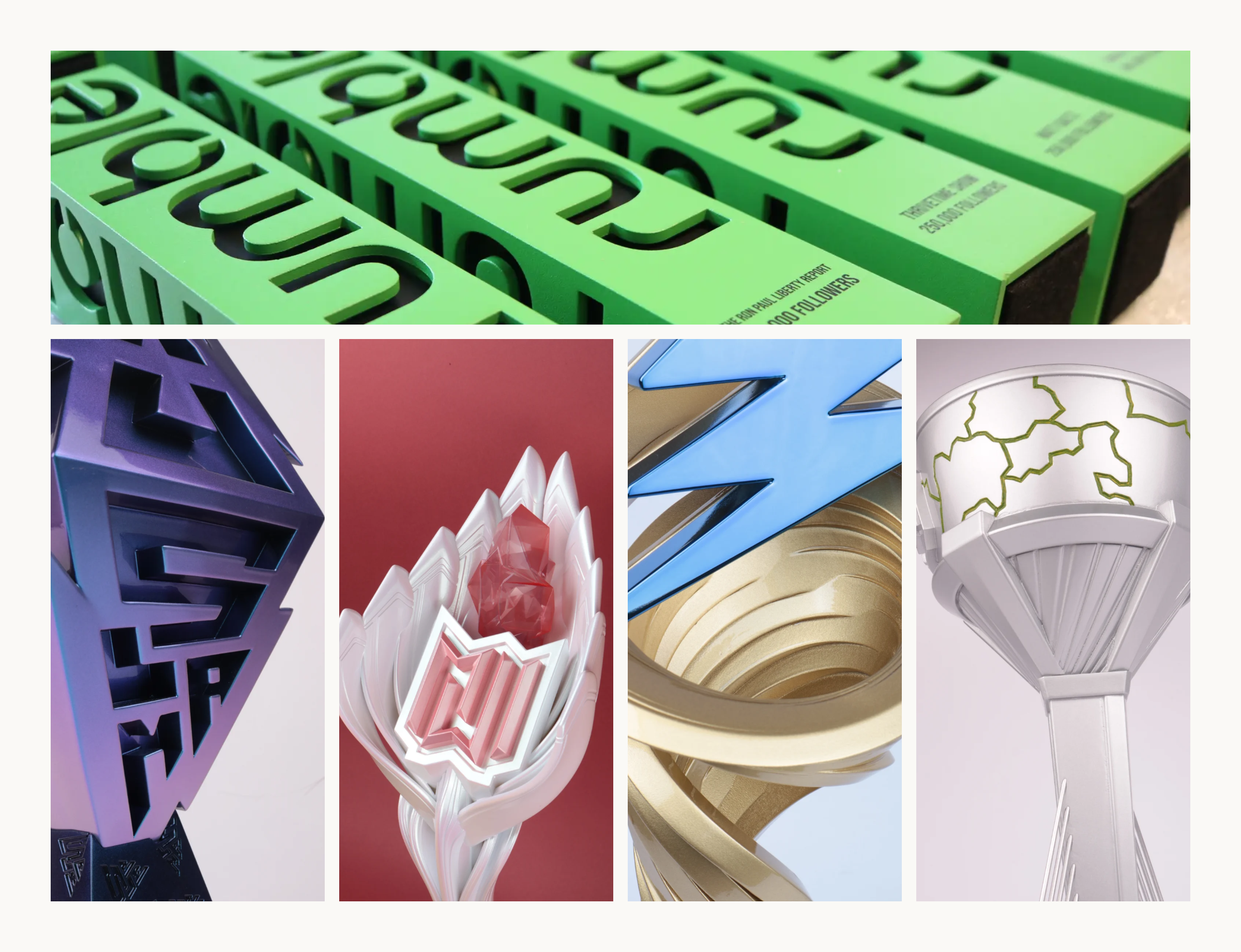
A NURBS model usually begins as surfaces, which are like infinitely thin skins. To become a manufacturable award, those surfaces are stitched together into a closed, solid volume. This is where NURBS connect to the idea of a watertight model, a form with no gaps, ready for production. The precision of NURBS makes this transition clean, which reduces errors and speeds the path to a finished object.
Where NURBS shine in trophy design
- Sweeping silhouettes, such as a rising wave, a spiral or an aerodynamic form, rendered without a single visible facet.
- Mirror finish surfaces, where any imperfection would be exposed by reflection.
- Precise, engineered bases, with crisp edges and controlled fillets.
- Smooth transitions, where one part of the form flows into another with perfect continuity.
- Scalable forms, that stay flawless whether produced small for finalists or large for a grand prize.
How NURBS support customisation and scale
Because NURBS surfaces are driven by control points and curves, they respond gracefully to adjustment. A curve can be made more dramatic or more restrained without rebuilding the model. This flexibility supports the kind of iterative, advisory design process clients value, and it pairs naturally with parametric methods when an award needs to exist in several coordinated sizes. When a client refines a concept, whether in direct conversation or through the choices offered by the online design tool, NURBS give the studio the means to translate those wishes into surfaces that look effortless.
The craft behind the mathematics
It would be a mistake to think NURBS do the work on their own. The mathematics guarantees smoothness, but the placement of control points, the number of curves, the discipline of keeping surfaces clean, all of that is human skill. A poorly built NURBS model can still look wrong. A well built one is the quiet backbone of a trophy that feels expensive from every angle. This is the kind of technical care that stands behind every 3D printed trophy that leaves the studio.
Frequently asked questions
Do I need to understand NURBS to order an award? Not at all. It is a tool the design team uses on your behalf. You experience it as beautifully smooth surfaces on the finished piece.
Are NURBS always better than meshes? No. They are better for smooth, precise, flowing surfaces. Meshes are better for organic, sculpted detail. The best awards often use both.
Will a NURBS design look mechanical or cold? Only if that is the intent. NURBS can produce warm, graceful, flowing forms just as easily as crisp, architectural ones.
Does using NURBS affect production choices? It supports clean, precise production and pairs well with polished finishes, but the surface quality benefits every method and material.
NURBS are, in the end, about honouring the curve. For a bespoke award that must look flawless in the hand, on a shelf and in a photograph, the smoothness NURBS deliver is not a technical footnote. It is the reason the finished trophy reads as the premium object it was always meant to be.
Related terms