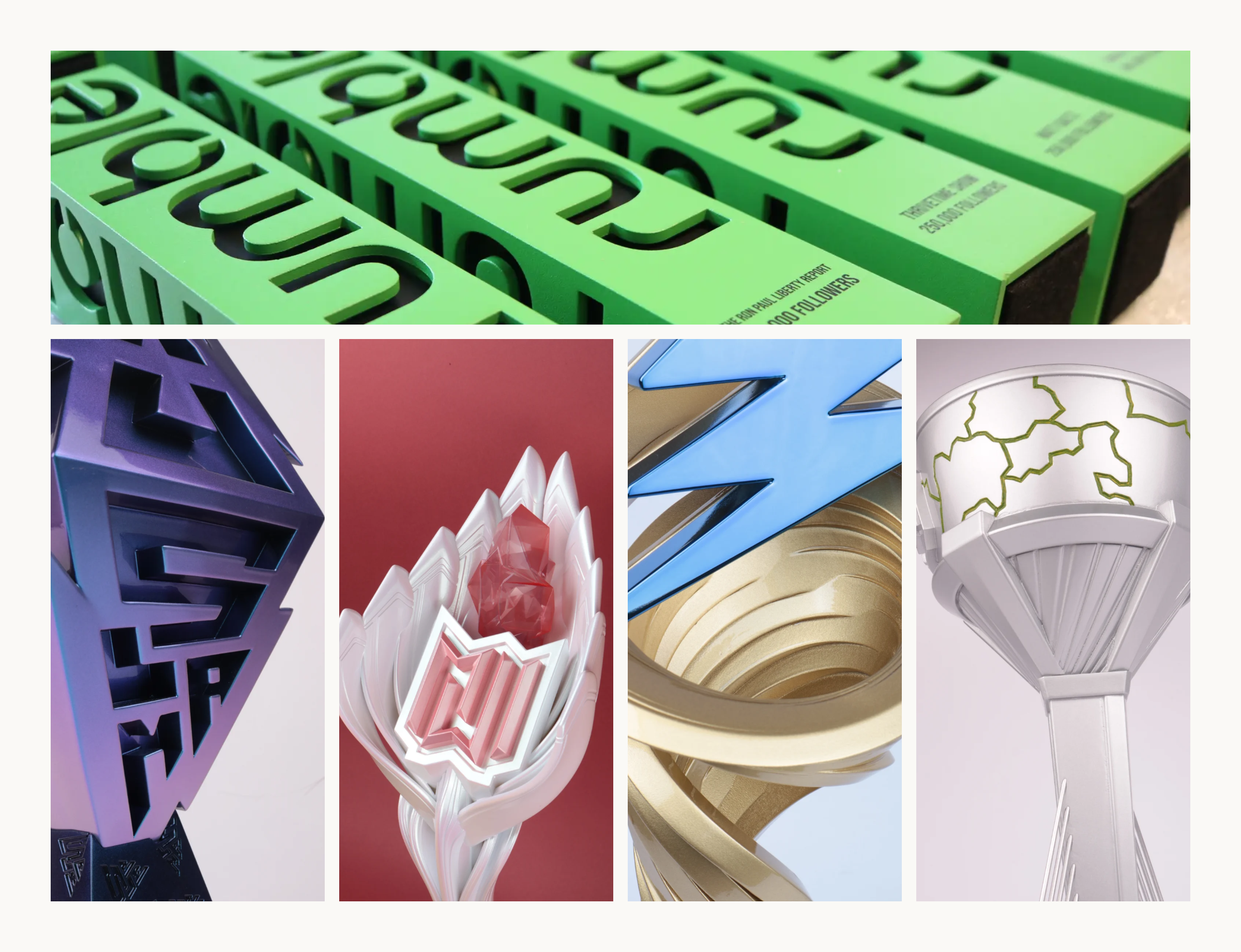
High relief is a sculptural approach in which the design projects boldly from its background, often by more than half of its natural depth, so that forms appear almost fully three dimensional while remaining attached to the surface. In award design, high relief creates maximum presence, dramatic shadow, and a sense of sculptural ambition that turns a trophy into a genuine art object.
Where shallow relief whispers, high relief speaks with confidence. It is the technique reserved for the most significant recognitions, the flagship awards of a ceremony, the pieces meant to be photographed and remembered. At Fabit, we reach for high relief when a client wants their award to feel monumental despite its modest size, and understanding it will help you decide whether it suits your own programme.
Defining high relief precisely
Relief exists on a scale defined by how far a design stands out from its background. High relief sits at the assertive end of that scale. Elements project so far that parts of the form may nearly detach from the surface, casting deep shadows and revealing sides that shallow relief would keep hidden. The result reads as sculpture that happens to have a back plane rather than a decorated surface.
This depth changes everything about how the piece is experienced. Light does not merely graze the surface, it wraps around raised forms and drops into recesses, producing contrast that gives the object life across a room. High relief is what makes an award look alive under stage lighting.
Why clients choose high relief for flagship awards
Not every award needs high relief, and part of our advisory role is saying so honestly. But for the centrepiece of a programme, the lifetime achievement, the grand prize, the once in a decade recognition, high relief earns its place. It signals gravity. It tells the recipient and the audience that this particular honour sits above the rest.
Corporate clients often commission a tiered set, with high relief reserved for the top category and gentler relief for supporting awards. We help structure these hierarchies within our custom trophy service, so the physical design mirrors the significance of each tier.
The engineering behind high relief
Bold projection introduces real engineering questions. The further a form stands out, the more leverage acts on its base, and the more vulnerable it becomes to knocks during handling and shipping. Because Fabit ships worldwide, we design high relief with transit in mind, reinforcing bases, softening exposed edges, and sometimes using undercuts strategically so the drama survives the journey.
Our in-house 3D design workflow is essential here. We simulate the physical form digitally, test its structural behaviour, and refine the relief before any material is committed. This is far safer and faster than discovering a weakness after production.
High relief and 3D printing
Modern additive manufacturing has transformed what high relief can achieve. Forms that would once have required a master carver can now be sculpted digitally and printed with precise, repeatable depth. Our 3D printed trophy approach makes high relief accessible for editions and series, not just one off pieces, because the depth is built into the digital model rather than carved by hand each time.
Material considerations for deep projection
High relief demands materials that can hold their own when pushed outward. Dense resins, metals, and engineered polymers cope well with projecting forms. Softer or more brittle materials require thicker sections to remain safe. The relationship between depth and material strength is one we always model before finalising a design, and our materials guide explains how each option behaves under sculptural stress.
Design decisions specific to high relief
- How far the boldest element should project without becoming top heavy
- Where to anchor deep forms so they remain robust during transport
- How shadows will fall under the specific lighting of the venue
- Whether undercuts are needed to enhance the three dimensional illusion
- How the deepest relief interacts with the trophy base for balance
- How to keep engraved names legible against a dramatic sculpted field
High relief versus sculpture in the round
A fully three dimensional sculpture can be viewed from every angle, while high relief remains anchored to a background and is designed for a primary viewing direction. This distinction matters for awards, which usually sit facing outward on a shelf. High relief gives most of the visual drama of full sculpture while keeping a stable, presentable orientation and a surface suitable for engraving and branding.
How high relief photographs and performs on stage
For most modern award programmes, the trophy lives a second life in photographs, press coverage, and social media long after the ceremony ends. High relief is exceptionally well suited to this reality. The deep shadows and strong contrast that bold projection creates translate powerfully to the camera, giving images a sense of depth and craftsmanship that flat or shallow pieces rarely achieve. On stage, where lighting is often dramatic and directional, high relief comes alive, catching key lights and throwing defined shadows that make the award read clearly even to an audience seated far from the podium. We take these viewing conditions seriously during design, considering how the piece will look under spotlights, in the hand of a recipient at the moment of the photograph, and later in the controlled lighting of a press image. Designing high relief with these downstream uses in mind means the investment in sculptural depth continues to pay off in every image the award appears in, extending its impact far beyond the evening it is presented.
High relief and long term display
Because high relief is a physical, sculpted form rather than a printed surface, it ages gracefully. There is no ink to fade and no coating to peel. The three dimensional form that gives the award its presence on day one continues to give it presence years later, which is exactly what a recipient hopes for from a meaningful honour. This permanence is one of the quiet arguments for investing in relief depth on a flagship piece.
Frequently asked questions
Is high relief suitable for every award in a set?
Usually not, and that is intentional. Reserving high relief for the top tier preserves its impact and creates a clear visual hierarchy across the programme.
Will high relief survive international shipping?
Yes, when designed for it. We reinforce and protect projecting forms specifically because we deliver worldwide.
Does high relief cost significantly more?
It involves more design and material, so it can, but the visual return is substantial. We quote transparently so you can weigh the value.
Can you match high relief to our brand identity?
Absolutely. We sculpt brand marks into bold relief while respecting proportion and guidelines, and we respond within 24 hours to begin the conversation.
Related terms