A financial tombstone is a commemorative object that records the completion of a financial transaction, taking its name from the plain bordered tombstone advertisements once used to announce securities offerings in newspapers. Today the phrase describes the physical trophy given to deal teams and clients, more casually known as a deal toy. At Fabit, we design and build financial tombstones in-house in Antwerp, combining 3D printing, machined metal, and craft finishing to move far beyond the printed acrylic block that defined the legacy US industry.
See how Fabit designs and builds deal tombstones
What is a financial tombstone?
A financial tombstone marks a moment in the life of a company or an investor: a merger, an acquisition, a public listing, a bond issuance, or a major financing round. It captures the essential facts of the deal, the parties, the value, and the date, in an object that will sit on a desk or shelf for years. The word tombstone can sound solemn, but the reality is celebratory. The object exists to honour work well done and to keep a landmark achievement visible long after the transaction has closed.
It is worth stressing how personal these objects become to the people who own them. A senior banker’s shelf of financial tombstones is, in effect, a career told in miniature, each piece anchored to a specific mandate, a specific team, and a specific stretch of long nights. Because the object outlives the paperwork and the press coverage, it carries a disproportionate share of the memory. That is precisely why the design deserves genuine attention rather than a default choice, and why Fabit treats every commission as an opportunity to make the memory as vivid as the work behind it.
The term comes from print advertising history. When a securities offering was completed, the underwriters would publish a formal notice in the financial press. These notices were deliberately restrained, using a plain typeface inside a heavy black border, and their sober appearance earned them the nickname tombstones. As banking evolved, the announcement moved from the page to the desk, and the tombstone became a three dimensional object.
How did tombstones evolve into objects?
For decades, the physical financial tombstone meant one thing: a slab of clear cast acrylic, or lucite, with the deal details printed on an insert sealed inside. A small number of American factories dominated this trade, and their moulded catalogue defined what a tombstone could look like. The result was consistency at the cost of character, with most pieces feeling interchangeable regardless of the deal they celebrated.
Fabit represents the next step in that evolution. By bringing design and manufacturing together in one Antwerp studio, we treat the financial tombstone as a bespoke object rather than a printed insert. A tombstone can now be a sculptural form in aluminium, a precise architectural model, or a mixed material piece that combines metal, acrylic, wood, and hand finishing. You can see the range on our 3D printed trophy page.
Why is it called a tombstone if it is a celebration?
This is one of the most common questions, and the answer is purely historical. The name refers to the visual style of the original print notices, not to anything sombre about the occasion. In practice, a financial tombstone is a proud object. It says a difficult transaction was completed, a team delivered, and a relationship was strengthened. The naming is a piece of financial heritage that the industry has kept out of affection for its own traditions.
What information goes on a financial tombstone?
A financial tombstone usually records a clear set of details so that anyone glancing at it understands the deal at a moment’s notice.
- Transaction headline: what happened, such as a sale, merger, listing, or financing.
- Parties involved: the companies, sponsors, or issuers, usually shown by logo.
- Transaction value: the amount, where disclosure is permitted.
- Closing date: the date the deal completed.
- Advisor roles: which firm acted as advisor, underwriter, or counsel.
Who receives a financial tombstone?
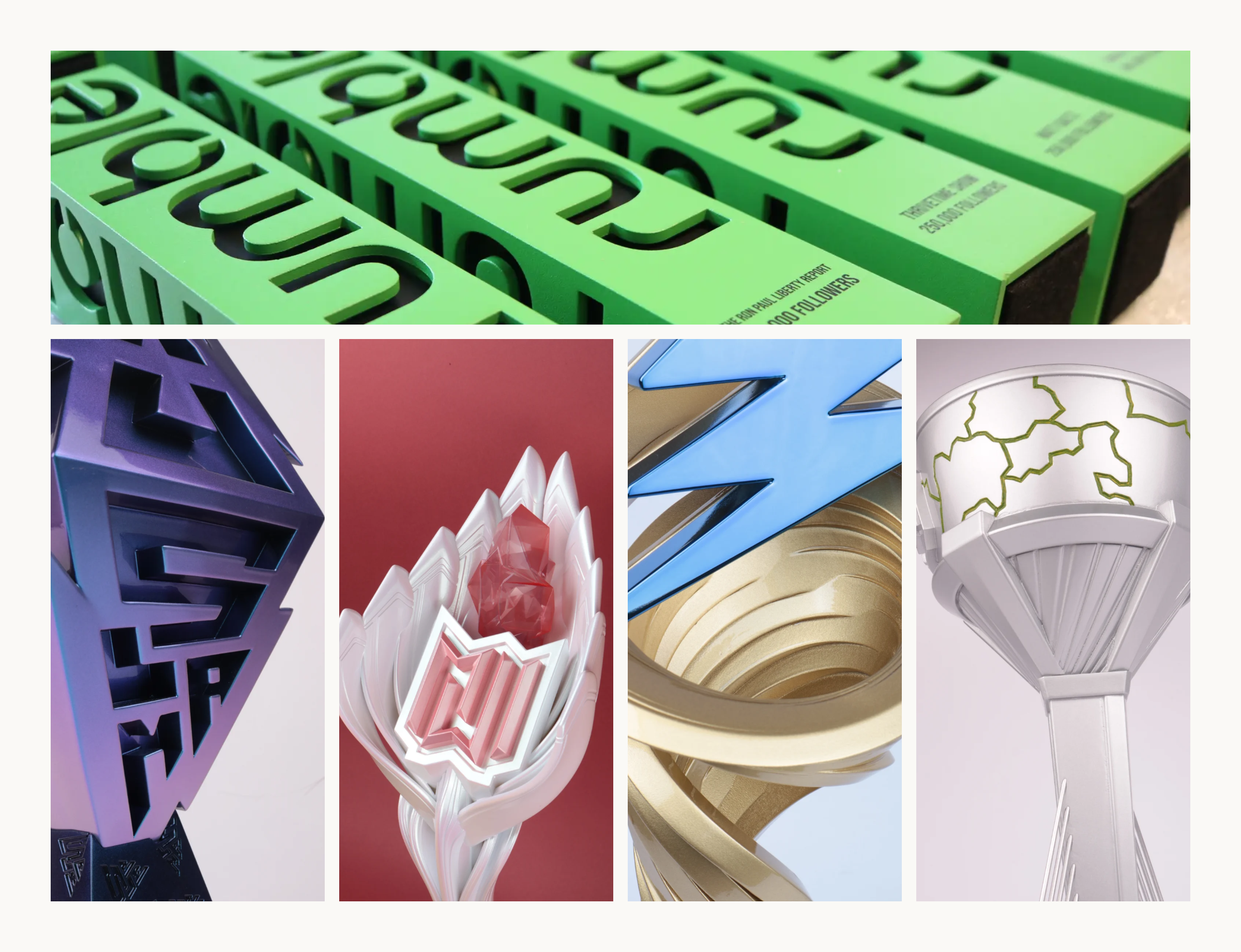
Financial tombstones are given to the people and organisations connected to a deal. The deal team at the advising bank receives them as recognition. Clients receive them as a gift that marks a shared success. Co-advisors, lenders, and legal counsel are often included as well. In private equity and venture capital, the founders and management of the company involved frequently receive a tombstone to celebrate an exit or a round. The object becomes a shared token across everyone who contributed.
What makes a Fabit financial tombstone distinctive?
The distinction is craft and design freedom. Rather than choosing from a fixed set of moulds, a Fabit client starts with the story of the deal. Our designers translate that story into a concept, and our Antwerp workshop builds it using 3D printing, CNC machining, and hand finishing. This means confidentiality is protected because nothing leaves our studio, timelines are shorter because we do not outsource, and every enquiry receives a response within 24 hours. Our work with banks and funds is detailed on our finance industry page.
How do you commission one?
Commissioning a financial tombstone with Fabit starts with a conversation about the deal and the impression you want the object to make. We then propose concepts, refine the chosen direction, and manufacture in-house before shipping worldwide from Antwerp. You can begin at any time through our online studio, and our advisory team will guide you through materials, scale, and quantity.
Frequently asked questions
Is a financial tombstone the same as a deal toy? Yes. Financial tombstone is the formal term rooted in print history, and deal toy is the everyday industry nickname for the same object.
Do tombstones have to be made of lucite? No. Lucite is the legacy default, but Fabit builds tombstones in metal, acrylic, wood, and combinations, allowing far more expressive designs.
Can transaction details stay confidential during production? Yes. Because Fabit designs and manufactures in-house in Antwerp, sensitive deal information never passes to external factories.
Can you produce tombstones for an entire deal team? Yes. We routinely produce matching sets for full teams as well as single presentation pieces, and we advise on the right run for your needs.
Related terms