Every custom trophy project eventually reaches the same fork in the road: cast it or print it? Both produce metal awards, both can look premium, and both have loyal advocates. The honest answer is that they solve different problems, and choosing well starts with understanding what each one actually does.
Casting suits large volumes of a single fixed design, where tooling costs are spread across hundreds or thousands of identical pieces. 3D printing suits bespoke, complex, or low-to-mid volume trophies where design freedom, speed, and zero tooling matter more than mass-production economics.
How each process actually works
Casting pours molten metal into a mould, usually created from a master pattern. Once that mould exists, every piece comes out the same, and the per-unit cost drops as volume climbs.
3D printing, specifically DMLS additive manufacturing, builds each trophy directly from metal powder using a laser, layer by layer. There is no mould and no tooling. The design file is the only master you need, which changes the economics entirely.
Fabit
Custom awards, designed and built in house
Fabit designs and produces custom awards for brands, ceremonies and programs. 3D design, in house production and worldwide delivery, with a response within 24 hours.
Where casting still wins
We are honest about this. If you need thousands of identical medals or a simple award repeated at massive scale, casting can be the more economical route. The upfront tooling investment is real, but it amortises across huge quantities.
Casting also has a long, respected heritage for certain classic forms. For a traditional, high-volume, unchanging design, it remains a valid choice.
Where 3D printing pulls ahead
For bespoke and premium work, additive manufacturing wins on nearly every axis that matters to a discerning client. There is no tooling cost, so a run of ten is viable. There is no mould, so revisions are cheap and fast. And there is no geometric limit, so the design can be as ambitious as your brief.
- No tooling investment: ideal for one-offs and short series.
- Design freedom: lattices, hollows, and undercuts that casting cannot release from a mould.
- Fast iteration: change the file, not the tooling.
- Consistency: every piece in a series is identical.
- In-house control: we own the timeline and the quality.
The detail question
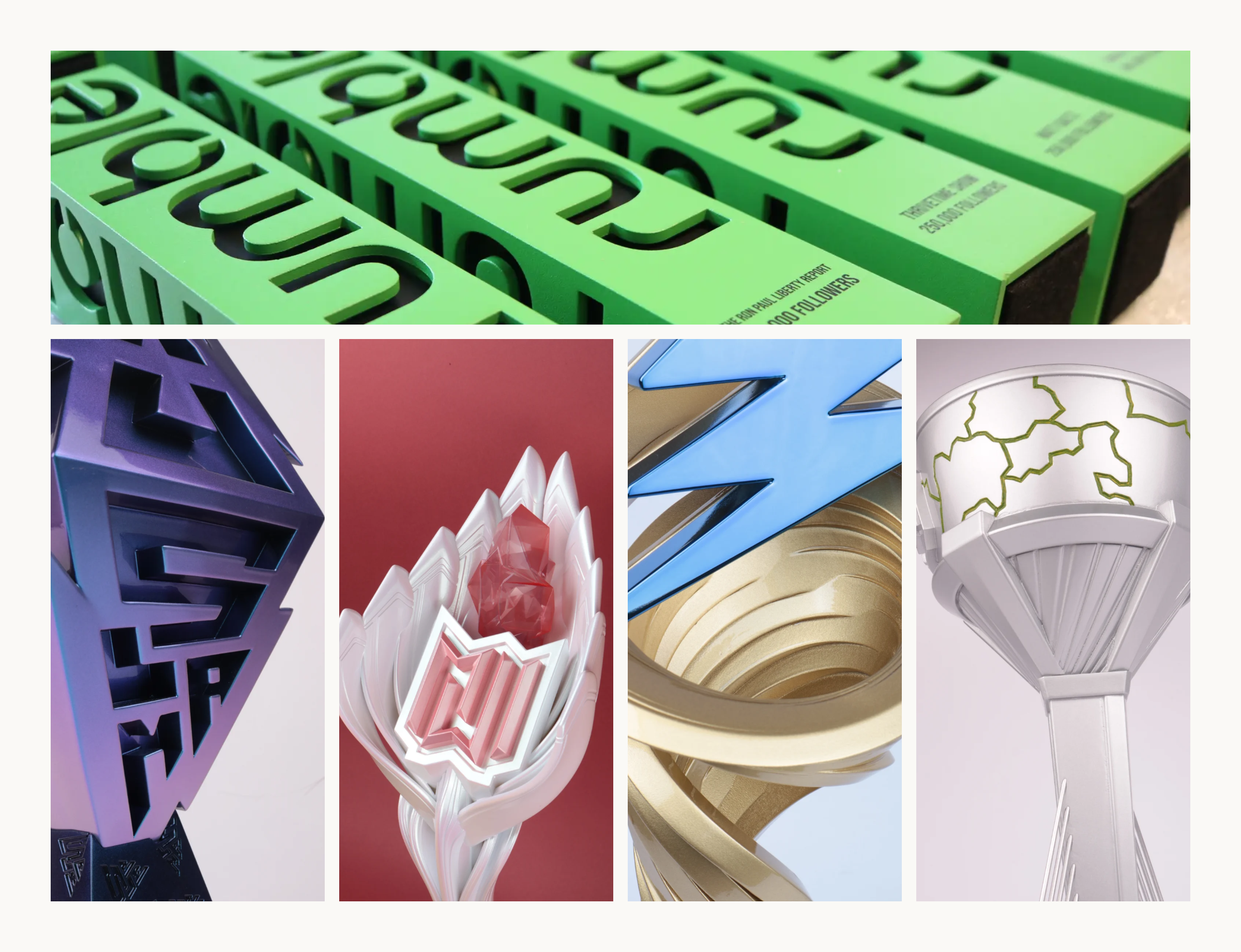
Cast pieces are limited by what a mould can physically release and by the shrinkage of cooling metal. Fine, intricate, or enclosed geometry gets softened or becomes impossible.
3D printing builds detail directly. Sharp edges, delicate structures, and internal features that would trap a mould are all achievable. For trophies that need to feel engineered and iconic, this is decisive. You can see the level of detail we reach on our 3D printed trophy page.
Cost, honestly compared
The real cost story is about volume and complexity, not one process being universally cheaper.
- Low volume, high complexity: 3D printing is almost always more economical, because there is no tooling to pay off.
- High volume, simple design: casting can win once quantities reach the hundreds or thousands.
- Design changes expected: 3D printing avoids re-tooling costs entirely.
For the bespoke, premium projects we specialise in, the numbers usually favour printing. But we will always give you the honest recommendation for your specific brief.
Speed and flexibility
Casting requires the mould to exist before anything is produced, which adds lead time at the front of a project. 3D printing skips that step entirely. Once the design is approved, we build.
Because we run additive manufacturing in-house in Antwerp, we control the schedule end to end. That is how we protect deadlines and respond to every enquiry within 24 hours.
Material and finish considerations

Both processes work in metal, but the properties differ. Cast metal can carry a traditional character, while 3D printed metal is fully dense and dimensionally precise. Both can be polished, brushed, or blasted to a premium finish.
The choice of material shapes weight, sheen, and durability regardless of process. Our full range is detailed on the materials page, so you can match the metal to the moment.
So which should you choose?
Choose casting if you need very high volumes of one fixed, simple design and are prepared to invest in tooling upfront. Choose 3D printing if you want a bespoke, detailed, or premium trophy, need short or medium runs, or expect the design to evolve.
For most custom trophy projects that value craft and individuality, additive manufacturing is the stronger choice. It is why we built our studio around it.
Frequently asked questions
Is 3D printing more expensive than casting?
Not for bespoke or low-volume work. Without tooling costs, 3D printing is usually more economical until you reach very high quantities of a single design.
Does a 3D printed trophy look as premium as a cast one?
Yes, often more so. Fully dense metal and fine detail, combined with hand finishing, produce a refined, iconic result.
Can you produce a large series with 3D printing?
Yes. Additive manufacturing keeps every piece identical, whether you need ten or several hundred.
Which is faster?
3D printing, in most cases, because there is no mould to make first.
Request a quote
Not sure which route fits your project? Tell us the design, the quantity, and the deadline, and we will give you an honest recommendation. Fabit engineers bespoke trophies in-house in Antwerp, with worldwide delivery and a 24-hour response. Request a quote today, or start shaping your idea at create.fabit3d.com.