Support structures are temporary, sacrificial scaffolds that a 3D printer builds alongside a part to hold up overhanging features, bridges and steep angles that would otherwise sag, droop or collapse before the material has a chance to solidify. They exist only to serve the build and are removed once printing is complete, yet the skill with which they are planned and removed has an outsized effect on the quality of a finished trophy.
Why supports are necessary
3D printing builds an object from the bottom upward, one layer at a time. Each new layer needs something beneath it to rest on. When a design includes an overhang, an outstretched arm on a figure, a cantilevered ledge, the underside of a curved dome, there may be nothing below that feature but empty air. Without support, the printer would be attempting to deposit material onto nothing, and the feature would droop or fail. Support structures provide that temporary foundation, giving every part of the model something to build against.
The same principle applies across technologies. In FDM the molten bead needs a surface to fuse to. In resin processes such as DLP, each layer must be held firmly as it is peeled from the vat, and supports also anchor the part to the build platform against those peeling forces. In both cases, supports make otherwise impossible geometry achievable.
The craft of support planning
Deciding where supports go is a genuine design skill. Too few and features fail; too many and the part is buried in scaffolding that must be removed, leaving marks behind. The art lies in placing just enough support, positioned so that its contact points fall on hidden or less visible surfaces. A well planned support strategy protects the piece while leaving the surfaces that matter most untouched.
Orientation is intimately linked to support planning. By tilting or rotating a model, we can often reduce the number of overhangs that need support at all, or steer the unavoidable contact points toward areas that will be hidden in the final display. These decisions are made during slicing and reflect a deep understanding of how the finished award will be seen.
Types of support structures
Not all supports are the same, and choosing the right kind matters.
- Standard supports: straightforward pillars and walls for general overhangs.
- Tree or organic supports: branching structures that touch the part at fewer points, reducing marks.
- Dense interface layers: a fine boundary where support meets part, easing clean separation.
- Rafts and brims: base structures that improve adhesion and stability during the build.
- Dissolvable supports: in some FDM setups, a second material that washes away entirely.
Removing supports and refining the surface
Once a print is complete, supports must be removed carefully. This is a delicate, hands on stage. Supports are detached, and the small contact witness marks they leave are refined away through sanding, trimming and smoothing. On resin parts from DLP printing this happens before or during curing; on FDM parts it follows the build. Skilled removal is invisible in the final piece, which is exactly the point. This work is part of the wider finishing programme detailed on our custom trophies service page.
Supports and design freedom
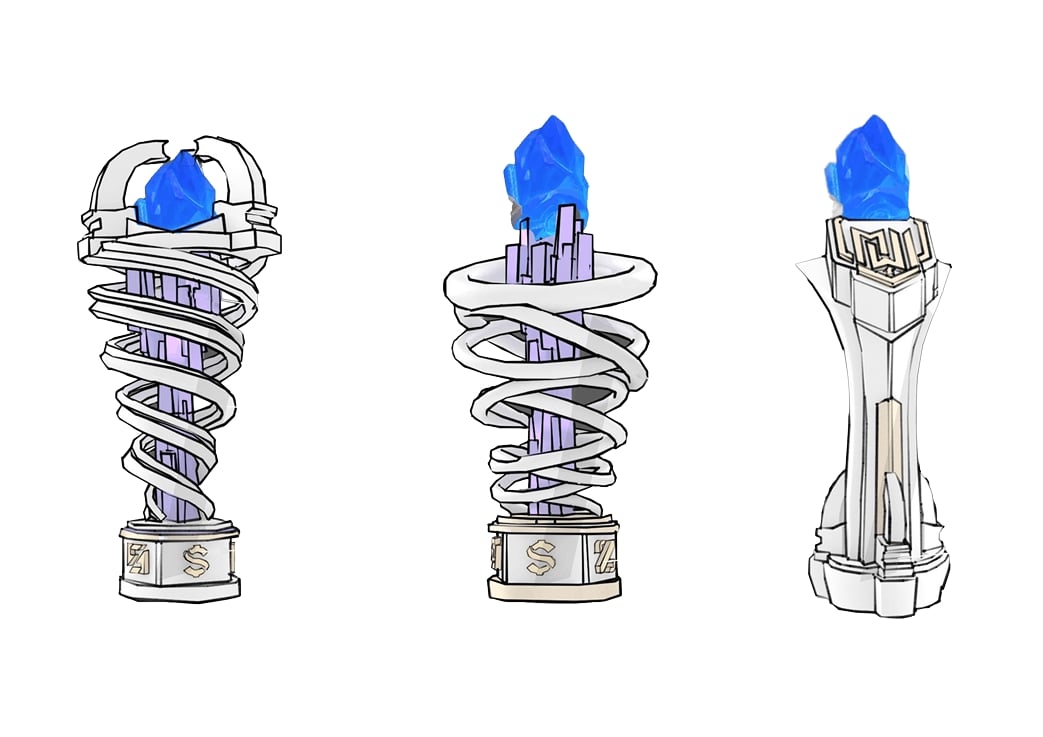
Far from being a nuisance, supports are what unlock the ambitious geometry clients love. Dramatic overhangs, floating elements and sweeping organic forms are only possible because supports hold them steady during the build. Understanding supports therefore expands, rather than restricts, what a design can be. When you explore the pieces on our 3D printed trophy page, much of the drama you see was made possible by intelligent support planning behind the scenes.
What this means for your project
As a client you never see the supports; you see only their absence in a flawless finished piece. Our team absorbs the complexity of planning, printing and removing them so you can focus entirely on the concept and the message. If your idea involves bold, gravity defying geometry, that is a conversation we welcome. Share it through our design studio and we will advise on how to bring it to life cleanly.
Why in house support work matters
Support planning and removal are areas where experience separates a clean result from a compromised one. An outside print service, working at volume and to a generic standard, has little incentive to agonise over where a support touches or how carefully a witness mark is refined. Because Fabit prints and finishes in house, the same team that cares about the finished award also decides how it is supported, and that care shows in the surfaces that matter. There is no gap between the person who understands the design and the person removing the scaffolding.
This attention is what allows us to accept ambitious commissions with confidence. Elaborate overhangs and delicate projecting features that might be declined elsewhere are, for us, simply a matter of thoughtful support strategy followed by patient hand finishing. It is also why we can promise consistency across a series and reliable delivery worldwide: the craft that hides the supports is ours to control from the first layer to the final inspection, backed by our commitment to reply to every enquiry within 24 hours.
الأسئلة المتداولة
Will I see marks where supports were attached? No. Support witness marks are refined away during finishing, so the delivered piece shows no trace of them.
Do supports make my trophy more expensive? Supports add material and, more significantly, finishing labour. We minimise them through smart orientation to keep both quality high and cost sensible.
Can any shape be printed with supports? Supports greatly expand what is possible, though extreme geometry may call for splitting a design into parts or combining processes. We advise on the best route for each concept.
Are supports removed by hand? Yes, largely. Removal and refinement are careful manual stages, which is why our craft expertise matters as much as the printing itself, and why we keep this work in house on every piece we produce and ship worldwide.
Related terms