
Best sports trophies in the world: iconic designs and what makes them great
The best sports trophies in the world are not simply prizes. They are objects that have accumulated meaning over decades or centuries of competition, vessels for the stories of athletes, teams, and moments that define what sport can mean. The most iconic sports awards are immediately recognizable around the world regardless of whether the viewer follows the sport that produced them. Their designs have become visual shorthand for excellence, achievement, and the aspiration that drives competitive sport.
This article examines some of the most celebrated and visually significant trophy designs in world sport, exploring what makes them iconic and what principles of design and cultural resonance they demonstrate.
What makes a sports trophy truly iconic
Iconicity in sports trophies develops at the intersection of design quality, competitive prestige, and cultural repetition. A trophy that appears in championship photographs, broadcast footage, and editorial coverage over many decades gradually accumulates a visual identity that transcends the sport itself and enters wider cultural consciousness.
The physical characteristics that support iconicity are consistent across the best examples. Scale that reads from a distance and on camera. A silhouette that is immediately distinctive and not easily confused with other awards. Material quality that communicates permanence and serious investment. These are design qualities that can be specified and evaluated.
But design alone does not create an iconic trophy. The competition it represents must matter. A beautifully designed award for an obscure event remains obscure. The trophies that become truly iconic are those that mark the summit of competitions that millions of people care about following, competing in, or aspiring to win.
Tradition amplifies iconicity over time. When the same trophy is presented year after year at the same event, its visual identity becomes inseparable from the event itself. Recipients join a line of predecessors whose photographs holding the same object create continuity. This is why many of the most iconic trophies in sport are perpetual, the same physical object presented repeatedly, not a new production each year.
The FIFA World Cup Trophy
The FIFA World Cup Trophy is the most universally recognized sports award in the world. Its current form, a solid 18-karat gold sculpture of two human figures holding up the Earth, designed by Italian sculptor Silvio Gazzaniga and introduced in 1974, is immediately recognizable to billions of people regardless of their relationship to football.
The trophy stands at 36.8 centimeters tall and weighs approximately 6.175 kilograms of solid gold. Its production cost is estimated at several million dollars, though its cultural value is incalculable. The gold globe at its summit is surfaced in green malachite, one of the few non-gold elements in an otherwise monolithic gold construction.
Notably, the actual World Cup Trophy is retained permanently by FIFA rather than given to the winning nation. Winners receive a gold-plated replica. The original perpetual trophy is kept in Zurich and brought out specifically for the final and the trophy ceremony. This arrangement preserves the physical object from the inevitable damage of global touring while maintaining its ceremonial role.
The trophy’s design has been analyzed extensively. The human forms suggest the dynamism of football players in motion. The globe evokes the global reach of the competition. The solid gold construction communicates the absolute premium character of the award. Every element serves the design’s purpose with unusual clarity.
The FA Cup
The FA Cup, contested by English football clubs since 1871, has a trophy that is itself a complex and often-replaced object. The current version of the FA Cup trophy, the fifth design, introduced in 2014, is a silver gilt cup standing approximately 61 centimeters tall in the tradition of Victorian cup trophies, with handles, a lid, and the ornate detailing characteristic of British silversmithing of the era it references.
The FA Cup’s iconicity derives almost entirely from historical depth rather than radical design innovation. The visual language of the cup, the handled trophy form, the silver color, the relatively modest scale compared to some modern trophies, is traditional to the point of understatement. What makes it iconic is that it is the FA Cup: the world’s oldest surviving football competition, contested by clubs ranging from Premier League giants to amateur sides.
The concept of the same trophy being competed for continuously since 1871 is itself a powerful narrative. Every great player, every memorable moment, every dramatic final reaches back through this lineage. The trophy is not just an award, it is a physical link to the entire history of the competition.
The design principle at work here is that cultural depth can substitute for design novelty in creating iconic status. The FA Cup does not need to be the most visually spectacular trophy in world football because it carries more historical weight than any competitor.

(Pictured: a custom trophy designed and produced by Fabit, not the trophy described in this section)
The Ashes Urn
The Ashes urn, contested between England and Australia in Test cricket, is one of sport’s great paradoxes of scale and significance. The urn itself is tiny, standing just 10.5 centimeters tall, and is a fragile terracotta object of Victorian manufacture. It is too fragile and too small to serve as a conventional trophy ceremony object, which is why a full-size replica is used for presentations while the original resides permanently at Lord’s Cricket Ground in London.
The Ashes urn is iconic because of story rather than design. According to tradition, it contains the ashes of the bails (or ball) from a match played in 1882 after England’s first home defeat by Australia prompted a mock obituary suggesting that English cricket had died and the body would be taken to Australia. The urn was presented to the English captain as a gift after a subsequent tour.
The cultural meaning accumulated around this object over more than 140 years of competition makes it one of sport’s most powerful examples of an artifact gaining meaning through narrative rather than design. The urn’s physical modesty, its tiny scale, its fragility, its plainness, has become part of its appeal rather than a limitation.
The contrast between the urn’s modest physical presence and the enormous significance of the competition that bears its name is itself a design lesson: objects do not need to be physically impressive to carry profound meaning, provided the cultural narrative surrounding them is sufficiently powerful.
The Henri Delaunay Trophy (UEFA European Championship)
The Henri Delaunay Trophy, contested at the UEFA European Championship, is one of football’s most visually compelling trophy designs. Named after the French football administrator who conceived the tournament, the trophy features a distinctive base structure with four curved legs rising to support the cup body, a form that creates a strong, immediately recognizable silhouette.
Unlike the World Cup Trophy, the Delaunay Trophy is presented to the winning nation rather than retained by UEFA, meaning that a new version must be produced for each tournament. The winning federation keeps the original; a replica is retained by UEFA. This practice means that multiple authentic Delaunay Trophies exist simultaneously, each belonging to a previous tournament winner.
The trophy’s design has been periodically updated while maintaining its essential form. The version used from 1999 onwards is larger and more substantial than the original, reflecting both the growth of the tournament and evolving expectations of what a major international championship trophy should look like.
The four-legged base structure, unusual in trophy design, creates an architectural quality that distinguishes the Delaunay from other major football trophies. Its silhouette is instantly distinguishable from the FIFA World Cup even in silhouette, which reflects good design thinking: a prestigious international trophy should not be confused with another prestigious international trophy.
The Larry O’Brien Championship Trophy (NBA)
The Larry O’Brien Championship Trophy, presented to the NBA Finals winner, is among the most photographed sports trophies in the world. Its form, a basketball passing through a net, rendered in gold-plated sterling silver, is a direct and visually unambiguous representation of the sport it celebrates. The specificity of this reference gives it an immediate legibility that more abstract trophy designs lack.
The trophy is produced by Tiffany and Co., which adds a layer of cultural prestige associated with luxury craftsmanship. Standing at approximately 56 centimeters tall and weighing around 6 kilograms, it has a substantial presence appropriate to the scale of the NBA and its global broadcast reach.
Every winning team receives a unique Larry O’Brien Trophy rather than a perpetual piece that is passed from year to year. This means each championship year’s trophy has slight variations, and each team retains their championship trophy permanently rather than yielding it to the next champion. This approach reinforces the sense that each championship is discrete and belongs fully to the team that won it.
The trophy’s position within American sports trophy design is as a clear and deliberate icon. Unlike the understated FA Cup or the narrative-dependent Ashes urn, the Larry O’Brien Trophy is designed for maximum visual impact on broadcast and in photography. It succeeds at this goal consistently.

(Pictured: a custom trophy designed and produced by Fabit, not the trophy described in this section)
The Claret Jug (The Open Championship)
The Claret Jug, officially the Golf Champion Trophy, presented to the winner of The Open Championship in golf is one of sport’s most elegant trophy designs. The current trophy, introduced in 1873, is a silver claret jug of classical proportions with engraved bands detailing every champion’s name and score from the early years of the competition onwards.
Like the FA Cup, the Claret Jug’s iconicity is inseparable from its historical depth. Every Open Championship winner’s name is engraved on the trophy, creating a continuous physical record of the competition’s history from 1873 to the present. The current trophy holds more than a century of names, with later years requiring the list to be compressed or continued on additional bands.
The design itself, a functional silver jug of the kind used at Victorian dining tables, is modest and entirely conventional by contemporary trophy standards. It does not announce itself as a major sports award in the way that a large, purpose-built trophy might. But this modesty is part of its character: it is an object borrowed from the everyday luxury of Victorian domestic life and elevated by competitive context and accumulated history.
The handling of the Claret Jug by each champion, photos of golfers kissing it, drinking from it, or simply holding it with evident emotion, contributes to its iconicity through the accumulated documentary record of these moments. The object has been part of thousands of significant photographs over its history, each one adding to its visual currency.
The Vince Lombardi Trophy (NFL Super Bowl)
The Vince Lombardi Trophy, presented to the Super Bowl winner, is perhaps the most visually distinctive trophy in American professional sports. Its form, a regulation-size football rendered in sterling silver, mounted vertically on a kite-shaped base, is immediately recognizable and uniquely specific to American football culture.
Designed by Tiffany and Co. and named after the legendary Green Bay Packers coach following his death in 1970, the trophy is produced anew for each Super Bowl rather than being passed from champion to champion. The specific Super Bowl edition is engraved on the base of each trophy, creating a permanent record of the championship year and the competing teams.
The trophy’s verticality and relative slenderness give it a different visual character from the cup-form trophies that dominate European sports. It broadcasts its specificity, this is a football, this is about American football, without requiring any familiarity with the sport to understand. Its silhouette is clear, strong, and unlike any other major sports trophy.
The production of a new trophy for each champion rather than a perpetual piece means that every Super Bowl winner has a legitimate, fully authentic version of the Vince Lombardi Trophy. This is a significant departure from the tradition of perpetual trophies in European sport, and it reflects a different cultural relationship with championship recognition where individual ownership is prioritized over shared custodianship.
The Webb Ellis Cup (Rugby World Cup)
The Webb Ellis Cup, presented to the Rugby World Cup winner, is named after the English schoolboy to whom the mythological invention of rugby is attributed. The trophy’s form is a decorative cup of traditional British silversmithing character, with handles, an ornate body, and a lid, closer in visual tradition to the FA Cup than to the functional minimalism of some modern sports awards.
The Rugby World Cup is contested every four years, which means the trophy is awarded less frequently than annual competition pieces and its presentation moments are correspondingly rarer and more significant. This infrequency contributes to the charged atmosphere surrounding the trophy ceremony at each World Cup final.
The trophy bears the inscription “International Rugby Football Board” on its base and stands at approximately 38 centimeters tall. It is one of the few major sports trophies where the engraved historical record of previous winners and the formal heraldic detailing of the cup itself both contribute significantly to the visual character of the piece.
Rugby’s physical culture, the sport requires exceptional physical strength and resilience, creates a particular emotional resonance around the moment when a team holds the Webb Ellis Cup at the end of a campaign. The contrast between the formal, traditional character of the trophy and the raw emotion of the players holding it is part of what makes the imagery powerful.
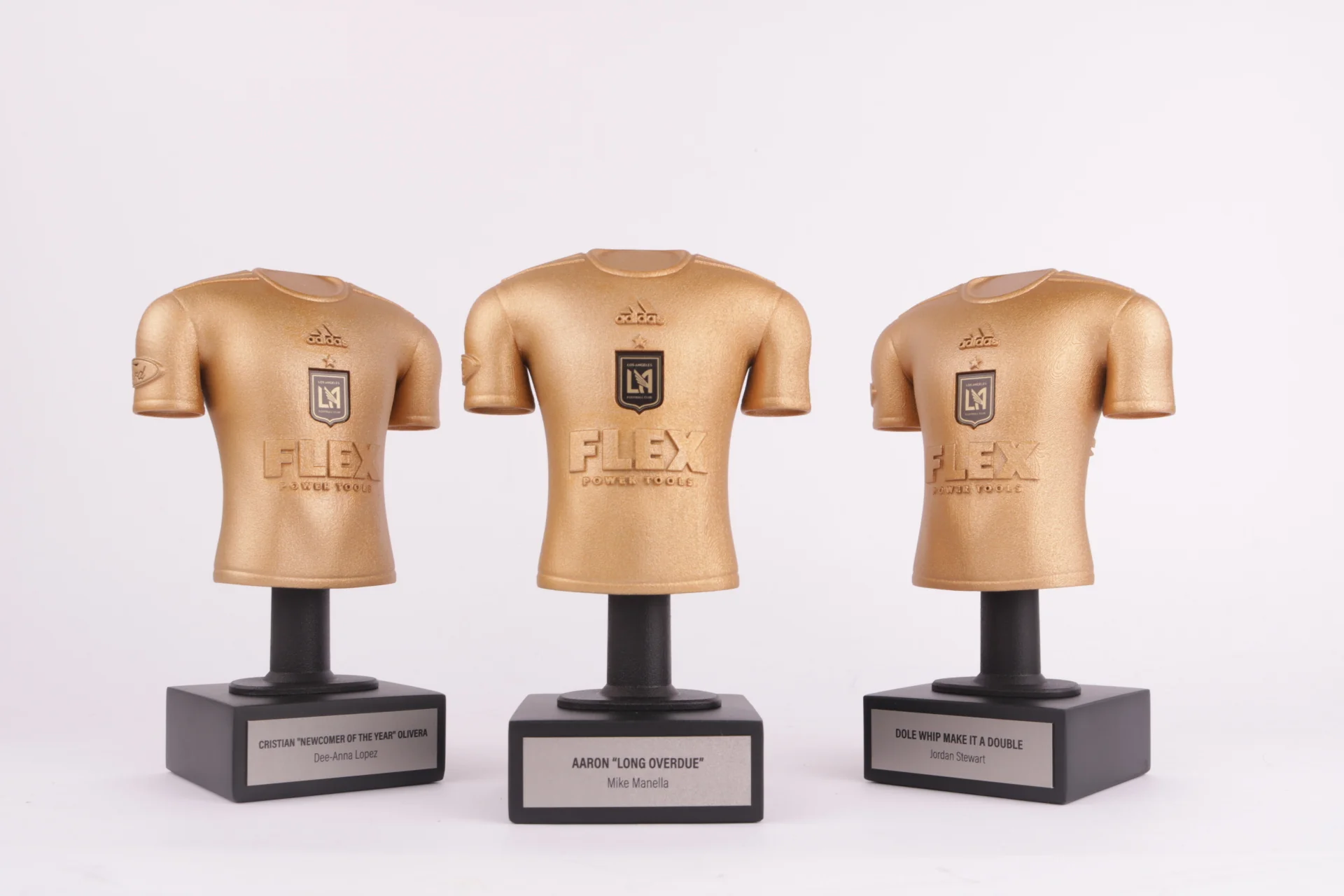
(Pictured: a custom trophy designed and produced by Fabit, not the trophy described in this section)
Design lessons from iconic sports trophies
Looking across these examples, several consistent principles emerge that distinguish iconic sports trophies from simply good ones. Understanding these principles is valuable for anyone commissioning a significant championship award.
Silhouette clarity is the most consistent property of great trophy design. The most iconic sports trophies in the world are immediately recognizable in silhouette, FIFA World Cup, Larry O’Brien Trophy, Vince Lombardi Trophy, because their forms are distinctive and not easily confused with any other object. Strong silhouette design is as important as surface detail.
Material authenticity at scale matters. The trophies that carry the most prestige use genuine precious materials, gold, sterling silver, optical crystal, at a specification and quantity that is unmistakably serious investment. The material statement these trophies make is part of their authority.
Historical depth cannot be designed in retrospect. The FA Cup, Claret Jug, and Ashes urn are iconic partly because they have accumulated decades of association with great competitors and memorable moments. For new trophies, the ambition should be to design something that will support the accumulation of meaning over time rather than exhausting its visual possibilities immediately.
Creating new iconic trophies for modern competitions
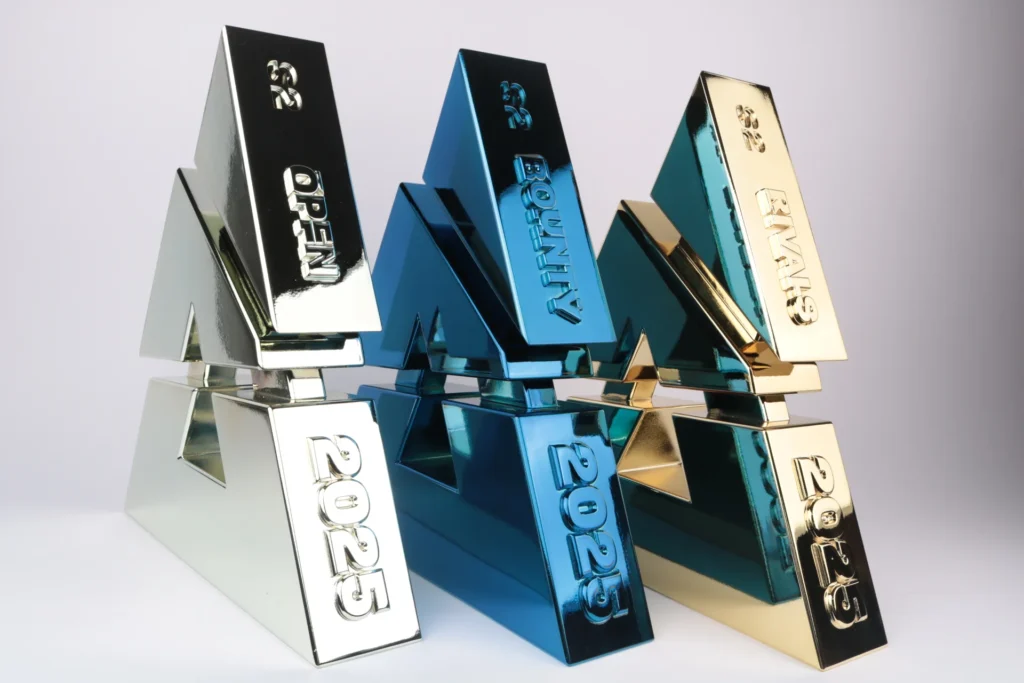
New sports competitions face the challenge of creating championship trophies that can become iconic without the benefit of historical depth. The approach taken by esports tournaments, commissioning visually spectacular, specifically designed pieces that are immediately associated with the competition’s visual identity, offers useful lessons.
Consistency over time is the most reliable route to iconicity for new competitions. A distinctive design presented at the same event year after year gradually accumulates the visual associations that create recognition. Changing the trophy design frequently, however well-intentioned, interrupts this accumulation process.
The sports industry has produced extraordinary trophy designs across centuries and cultures, and the principles that make the best ones iconic are consistent enough to provide genuine guidance for new commissions. Design quality, material authenticity, visual distinctiveness, and the commitment to present the same award repeatedly at a significant event are the foundations of a trophy that can aspire to iconic status.
Commissioning a championship trophy with genuine ambition, allocating adequate budget for design, prototyping, and premium materials, is an investment in the competition’s identity that pays back over many years through the visual equity created by a design that deserves the recognition it represents.
What great trophies teach about recognition
The best sports trophies in the world teach consistent lessons about what makes recognition objects genuinely powerful. Design quality, material authenticity, and visual distinctiveness are necessary conditions. But they are not sufficient without the cultural context of a competition that matters, and the commitment to present the same award to the world’s best competitors over time.
For organizations commissioning significant sports awards, understanding these dynamics helps them make design decisions that are worth the investment, objects that can carry the weight of achievement and grow in meaning with each passing championship.