
Private equity firms close a lot of deals, which is exactly why most of their deal toys end up in a drawer. When every acquisition earns the same clear block with a logo dropped inside, the objects stop meaning anything. The pieces that portfolio teams actually keep are the ones that feel considered: bespoke, sector-aware, and engineered well enough to hold their place on a shelf that is already crowded.
The private equity deal toys that last are the ones designed around the specific business acquired, not a house template. Tie the object to the portfolio company’s product or sector, choose premium materials, and keep a coherent design language across the fund so the collection reads as a track record.
Why most PE deal toys get thrown away
Volume is the enemy of meaning. A firm doing many deals a year develops a house block, orders it in bulk, and every acquisition looks identical. After a while the objects blur together and lose the one thing a deal toy is supposed to do: mark a specific moment.
The fix is not spending more on every deal. It is designing the pieces so each one connects to the business behind it. A commemorative object that references the actual company feels earned, and earned objects stay on desks.
Fabit
Deal toys and tombstones, made in house
Fabit designs and produces custom deal toys, lucite tombstones and IPO gifts for banks and investors. 3D design, in house production and worldwide delivery.
Design around the portfolio company, not the fund
The strongest private equity deal toy ideas start from the acquired business. A manufacturing acquisition can feature a refined miniature of the product. A logistics deal can borrow the geometry of a container or a route. A consumer brand can be embedded in a clear form that shows the product itself.
This is where in-house 3D printing changes what is possible. Instead of forcing every deal into the same shape, each piece can be modelled around the company it commemorates. The fund’s identity stays present in the finish and the base, while the hero of the object is the business the team actually worked on.
Ideas that portfolio teams are proud to display

A few directions consistently produce pieces that survive the drawer test.
- The product miniature: a 3D printed and finished model of what the portfolio company makes, mounted on a metal base with the deal details.
- Sector-specific geometry: a form borrowed from the industry, an engine part, a building, a vessel, engineered as a sculptural object.
- The embedment record: a transparent block with a physical artefact from the business suspended inside.
- The value monolith: the deal size or entry milestone rendered as a clean metal form for the principals.
- The exit companion: a matched second piece created at exit, so entry and exit sit together as a pair.
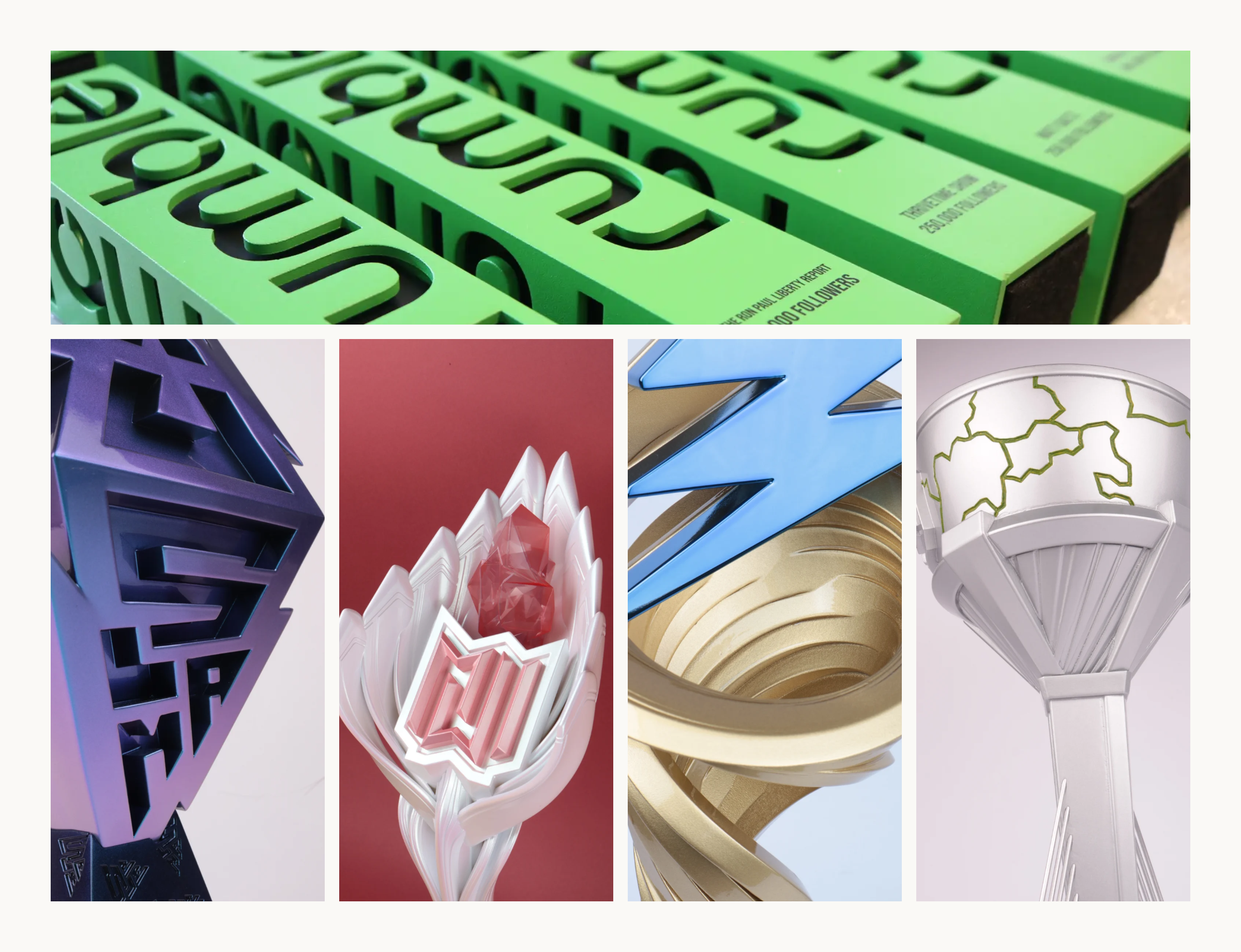
Because everything is produced in-house across printing, metal and craft, these can vary by deal while staying unmistakably part of the same fund’s language.
Materials that hold their place on a crowded shelf
Portfolio professionals accumulate deal toys, so a new one has to earn its position. Weight and material do most of that work. A solid metal base signals permanence. A clean embedment signals clarity. A thin, hollow or plasticky piece gets displaced by the next one within weeks.
The finish is where premium shows. Deep, crisp engraving, a considered base and a tactile weight all tell the recipient the piece was made with care. Those are the objects that stay in view rather than migrating to storage.
Build a coherent language across the fund
The most sophisticated private equity firms treat their deal toys as a set. Each piece is different because each business is different, but a shared base material, a consistent way of presenting the fund mark, and a common finish tie them together. Lined up on a shelf, they read as a track record rather than a random pile.
This coherence is a strategic asset. When a founder or co-investor visits the office and sees a shelf of considered, distinct pieces, it communicates discipline and pride in the portfolio. A wall of identical blocks communicates the opposite.
Plan for entry, add-ons and exit
Private equity ownership has a lifecycle, and the deal toys can follow it. A piece at entry marks the acquisition. Smaller companion pieces can mark significant add-ons or milestones. A final piece at exit, designed to sit alongside the entry object, closes the loop and often becomes the most valued of all.
Designing with this arc in mind means the pieces relate to each other rather than accumulating at random. It also gives the team a reason to keep them together, which is exactly the outcome a firm wants.
Explore finished work across our finance deal toys, our custom trophy and award service, and what a 3D-geprinte trofee makes possible for sector-specific designs.
Veelgestelde vragen
We do many deals a year. Can each one be different affordably?
Yes. In-house 3D printing lets each piece reference its own business while sharing a base language, without bespoke tooling costs on every deal.
Should the fund brand or the portfolio company lead the design?
Usually the portfolio company leads as the hero, with the fund mark present in the base and finish. That is what makes teams keep them.
Can you create matching entry and exit pieces?
Yes. Designing a companion piece at exit that pairs with the entry object is one of the most valued options for PE clients.
Do you ship to portfolio companies worldwide?
Yes. Based in Antwerp, we deliver worldwide with a 24-hour response on every enquiry.
Commission deal toys your teams will actually keep
Private equity produces enough deal toys that only the considered ones survive. Design each piece around the business behind it, engineer it in premium materials, and keep a coherent language across the fund, and the collection becomes a track record your teams are proud to display.
Tell us about your next close and the business behind it, and we will design something worth keeping. Offerte aanvragen to start. Worldwide delivery, 24-hour response.