How to brief a trophy manufacturer to get the result you actually want
A strong trophy brief is the foundation of every successful custom award project. It communicates your requirements clearly, gives the manufacturer the context they need to propose something appropriate, and reduces the likelihood of misunderstandings that lead to costly revisions or disappointing results. Yet many organizations approach trophy manufacturers with briefs that are vague, incomplete, or missing critical information.
This guide explains how to write an effective trophy design brief. It covers the information that matters most, how to communicate it clearly, and the common mistakes that cause well-intentioned projects to go off track.
Fabit
Custom trophies, engineered in 3D
Fabit designs and produces fully custom trophies for brands and global events. 3D design, in house production in Antwerp and worldwide delivery, with a response within 24 hours.
Understand what a brief actually needs to achieve
A trophy brief serves a specific function: it gives the manufacturer enough information to propose a relevant solution and price it accurately. A brief that fails this test, because it is too vague, incomplete, or internally inconsistent, produces proposals that miss the mark or quotes that bear no relation to the final cost.
Think of the brief as a contract with your own intentions. Writing it forces you to make decisions and resolve ambiguities before they become problems during production. Many organizations discover gaps in their own planning when they try to write a proper brief for the first time.
A good brief also protects you. If the finished trophy does not match what was agreed, the brief provides the standard against which the discrepancy can be measured. This is particularly important when dealing with new suppliers or when the project involves significant budget.
The brief is not a creative constraint, it is a creative enabler. A manufacturer who understands your audience, your brand, your values, and your timeline is far better positioned to propose something genuinely appropriate than one working from a two-line email asking for a trophy by a certain date.
Start with context and purpose
The first section of any trophy brief should explain the context and purpose of the award. What is it for? Who will receive it? On what occasion will it be presented? These questions may seem basic, but the answers fundamentally shape every design decision.
Context includes the type of event or program the award belongs to. A championship trophy for a sports league, a recognition award for a corporate program, and a participant trophy for a youth competition all call for very different design approaches. Be specific about the category and the scale of the occasion.
Purpose goes beyond the occasion itself to the meaning the award is intended to carry. Is it recognizing performance, tenure, achievement, creativity, or something else? An award for outstanding innovation should feel different from one for years of service. These distinctions matter in design terms.
The recipient profile deserves its own paragraph in the brief. Describe who the recipients are: their professional context, how they are likely to display the award, and any relevant cultural or contextual factors. An award displayed in a law firm’s reception area needs to feel different from one displayed in an esports player’s home.
Be explicit about design direction
Many trophy briefs fail at the design direction stage because they rely on adjectives that mean different things to different people. “Modern”, “premium”, “elegant”, and “impactful” are all meaningless without visual reference points to anchor them. Replace adjectives with references wherever possible.
Collect images of awards, architecture, product design, or other visual references that capture the feeling you are aiming for. Equally useful are examples of what you want to avoid. “Not this” is often more precise and more useful to a designer than any amount of descriptive language.
If your organization has a visual identity, logo, colors, typography, graphic style, include these assets and explain how they should be referenced in the trophy design. Some briefs call for awards that strongly reflect the organization’s brand. Others call for designs that are more independent but consistent with a general aesthetic direction.
State any design constraints clearly. If the trophy must incorporate a specific logo element, accommodate a particular type of personalization, or fit within defined dimensional limits, these requirements should appear prominently in the brief rather than emerging as surprises during the review process.
Specify materials if you have preferences
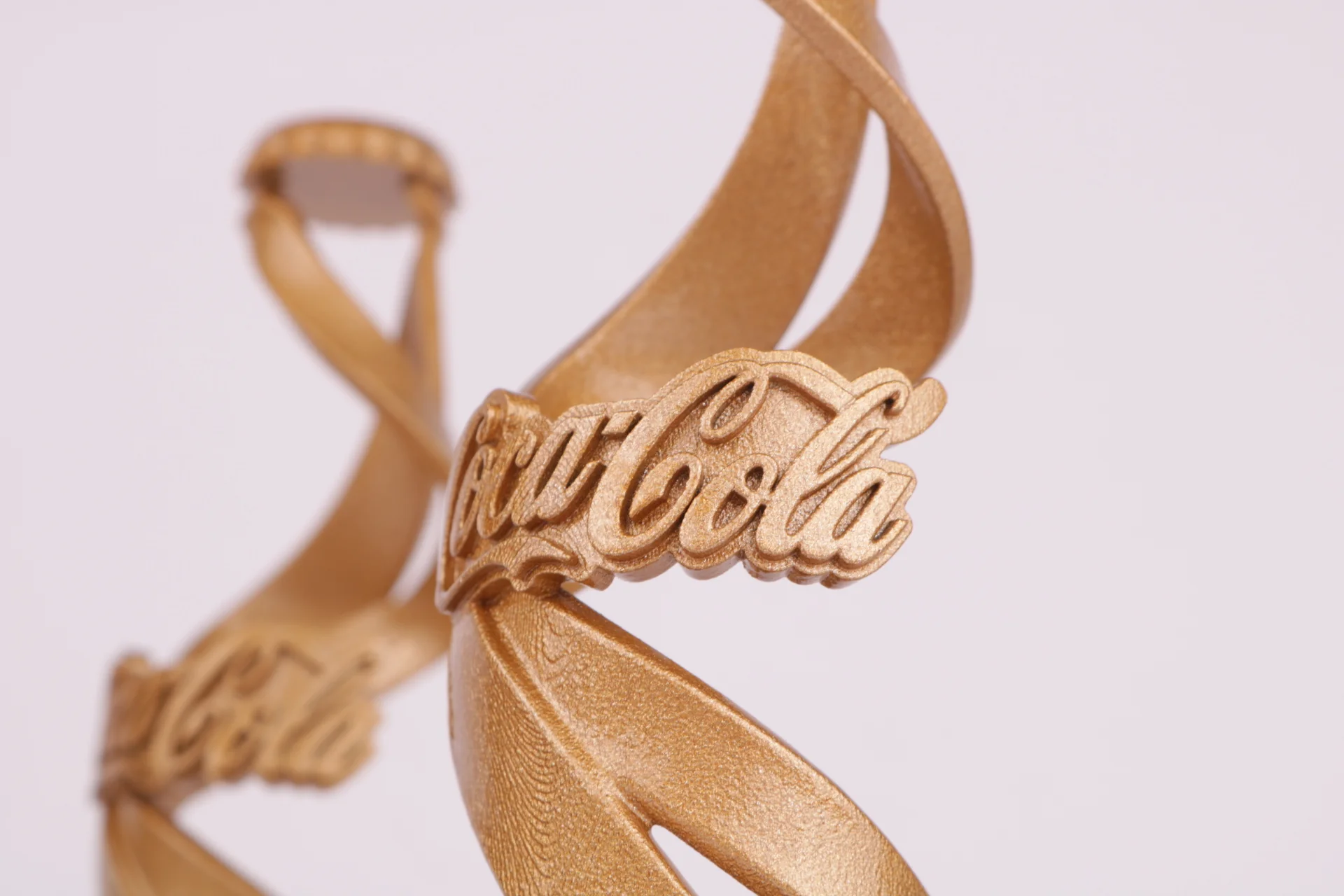
If you have clear material preferences, include them in the brief. If you have a preference for metal trophies, or for glass rather than acrylic, state this. Unexplained material preferences can seem arbitrary to a manufacturer, so if the preference has a reason, brand alignment, sustainability commitment, audience expectation, include that context too.
If you have no strong material preference, say so explicitly and invite the manufacturer to recommend the most appropriate option given your other requirements. This gives manufacturers creative latitude that can produce more interesting proposals than a tightly constrained brief.
Material affects cost significantly. If budget is a key constraint, say so, and note that you are open to material suggestions that achieve the visual result within budget. This prevents manufacturers from proposing expensive solutions when a more economical material would serve the brief just as well.
Finish preferences, matte, gloss, brushed, antique, colored, can also be specified if you have views. Finish has a strong effect on the perceived character of a piece and is worth addressing explicitly rather than leaving to chance.
Quantify the order clearly
Quantity is one of the most important pieces of information in a trophy brief, because it affects production method, timeline, and cost more than almost any other variable. State how many trophies are required, broken down by type or tier if there are different specifications within the same order.
If quantity is uncertain, because a competition field has not been finalized, for example, give the manufacturer a range and identify which figure to use for pricing purposes. Most manufacturers can accommodate some quantity variation around a confirmed order, but they need a working number to build a proposal.
If the order includes different variants, winner, runner-up, and participant trophies from the same program, for example, describe each variant and the quantity of each. Make clear which elements are shared across variants and which differ.
Be honest about the possibility of repeat orders. If this is an annual award that will be produced each year with minor updates, the manufacturer may be able to structure tooling and production setup costs to account for that. Withholding this information prevents the manufacturer from proposing the most cost-effective approach.
State personalization requirements in detail
Personalization is often treated as an afterthought in trophy briefs, but it is one of the most complex elements to manage in production. The brief should specify exactly what information will appear on each trophy, where it will appear, in what format, and by what production method.
Typical personalization elements include recipient name, award category, event name, organization name, and year. State which of these are required, which are optional, and whether there are any character limits or format conventions that apply.
Specify the preferred personalization method: engraving, UV printing, pad printing, or another technique. Different methods have different aesthetic qualities and suit different materials. If you do not have a preference, ask the manufacturer to recommend the most appropriate method for the design.
Explain how personalization data will be provided. Will it be supplied as a spreadsheet after production is confirmed? Will some data be unknown until close to the event? Understanding the data timeline helps the manufacturer plan the production schedule accordingly.

Set out the timeline clearly
Timeline information needs to be precise. Do not describe your timeline as “urgent” or “as soon as possible”, state the actual delivery date and explain why that date is fixed. If there is a ceremony date that cannot move, name it.
Work backwards from the delivery date to identify the key milestones you need from the manufacturer: when you expect to see initial design concepts, when prototypes should be ready for review, and when the final production run needs to begin. This gives the manufacturer a framework for their proposal and highlights immediately if the timeline is unrealistic.
If the timeline is tight, acknowledge it and invite the manufacturer to advise on what is achievable within it. Trying to conceal a compressed timeline to avoid paying a rush premium creates problems later. A manufacturer who knows the real deadline can plan accordingly; one who discovers it partway through the project has far fewer options.
If there is any flexibility in the timeline, state this too. Manufacturers may be able to offer better pricing or more design iterations if an additional two or three weeks are available. Flexibility is a genuine asset in the brief and should be communicated, not hidden.
Provide packaging and delivery specifications
Many briefs focus entirely on the trophy itself and neglect the packaging and delivery requirements, both of which affect cost and logistics significantly. Include your requirements in both areas to get an accurate and complete quote.
Describe the packaging you expect. Will the trophy be delivered in a generic box with foam protection, or do you need custom-branded packaging? If there is an unboxing experience to consider, because recipients will receive the award by mail rather than in person, packaging becomes part of the presentation and deserves specific requirements.
Delivery destination matters for quoting. A single delivery to one address is very different from shipping individual trophies to three hundred recipients at separate locations. Both the shipping cost and the logistical complexity are significantly different, and the manufacturer needs accurate information to quote for either.
If the delivery location involves import customs, because the manufacturer is based in a different country from the recipient addresses, include this in the brief. Customs procedures, import duties, and required documentation all affect both the timeline and the total cost.
Be clear about budget parameters
Budget conversations feel uncomfortable in many procurement contexts, but withholding budget information from a trophy manufacturer rarely serves the client’s interests. Without a budget figure, manufacturers may propose solutions at the wrong price point, either far above what you can afford, or far below what would be appropriate for the occasion.
State a target budget per unit or a total project budget, whichever is more useful. If there is a hard ceiling, say so. If the budget has some flexibility for the right solution, indicate that. The goal is to give the manufacturer enough information to calibrate their proposal appropriately.
If budget is genuinely unknown at the time of briefing, ask the manufacturer to present options at different price points. A good manufacturer can propose a range of solutions at different investment levels, which can help you calibrate your own expectations and secure appropriate internal budget approval.
Pricing for custom awards varies enormously depending on material, complexity, quantity, and lead time. A per-unit cost guide from the manufacturer at the briefing stage, based on your approximate requirements, can save significant time and prevent projects from advancing through design stages before fundamental budget constraints are identified.
Include your contact and approval process
Make it easy for the manufacturer to communicate with you by providing clear contact information for the right person, not just a general inbox. Identify who has authority to approve design concepts, who will review prototypes, and who can authorize production to begin.
Describe your internal approval process if it is relevant to the timeline. If design sign-off requires three layers of internal review, the manufacturer needs to know this to build a realistic project schedule. If you can turnaround feedback within 48 hours, that is also useful information.
If your organization has procurement requirements that the manufacturer needs to accommodate, supplier registration, insurance documentation, purchase order processes, include this in the brief so it can be addressed before work begins rather than causing delays later.
State your preferred communication method and frequency. Some clients prefer regular status updates by email; others want to be contacted only at key milestones. Aligning on communication expectations from the outset prevents unnecessary friction during the project.
Review your brief before sending it
Before the brief goes to manufacturers, read it as if you were receiving it for the first time with no prior knowledge of the project. Is every requirement clear? Could anything be interpreted in more than one way? Is there anything a manufacturer would need to ask about that you have not addressed?
Ask a colleague who has not been involved in drafting the brief to review it. Fresh eyes catch gaps and ambiguities that the author is too close to notice. Even a five-minute review by someone unfamiliar with the project often surfaces questions that the brief has failed to answer.
Send the same brief to all the manufacturers you are approaching. Identical briefs produce comparable proposals. Modifying the brief between suppliers, intentionally or not, makes it impossible to evaluate responses fairly and may cause you to make decisions based on incomparable information.
Keep a copy of the final brief that was sent for reference throughout the project. When questions arise during design or production, the brief is the authoritative source of what was agreed. Returning to it regularly keeps the project grounded in the original intent.
The brief that gets the right result
The quality of a trophy brief is a reliable predictor of the quality of the award it produces. Manufacturers work from the information they are given, and a brief that is clear, complete, and well-considered gives them the best possible foundation for excellent work. The effort invested in writing a strong brief pays back many times over in reduced revisions, more accurate quotes, and a final result that matches expectations.
Treat the brief as a genuine communication of your intent rather than a formality to be completed as quickly as possible. The awards that organizations are proudest of are almost always the ones where the brief made clear what the award needed to be and why.